
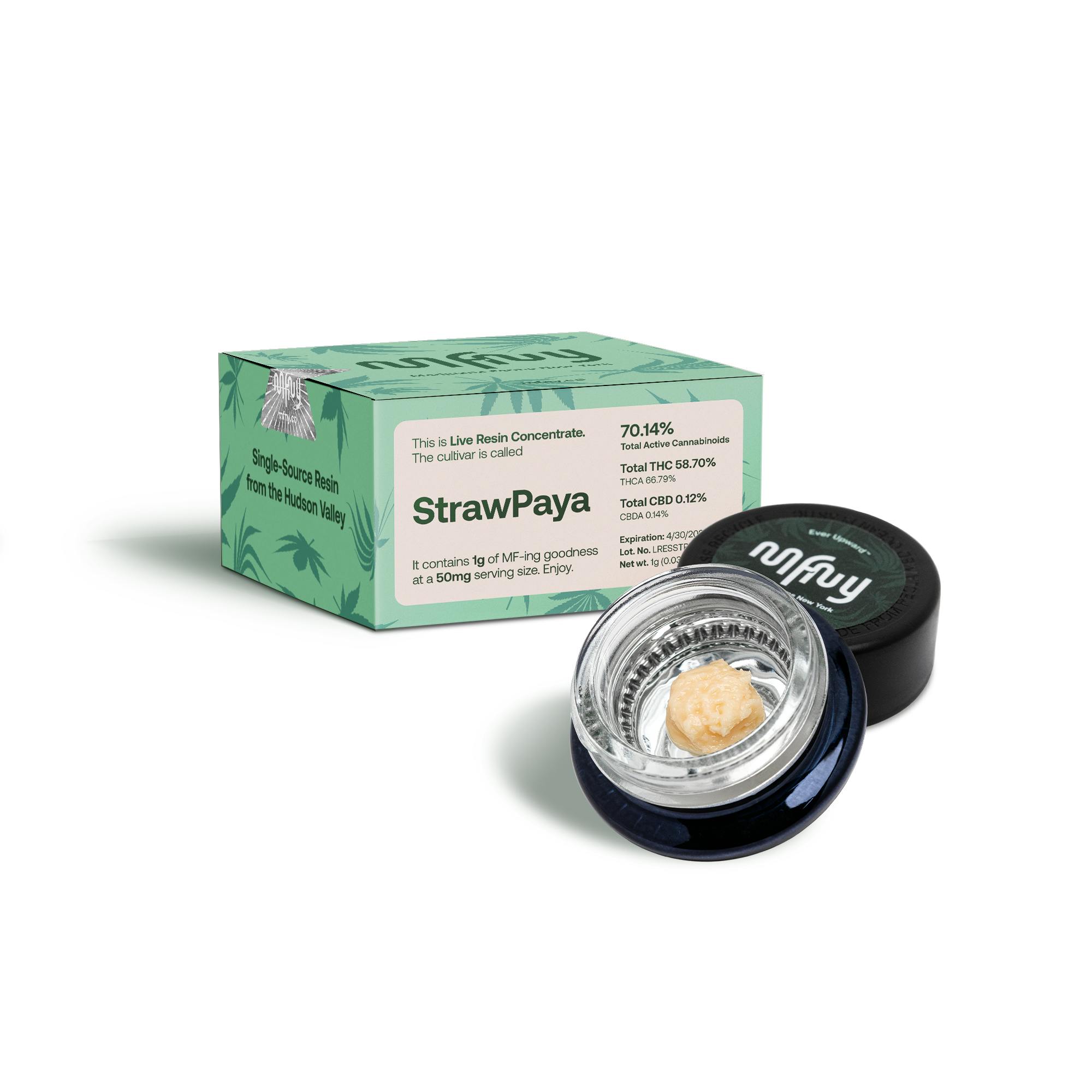
Sativa
All strains Strawpaya
2 live products in stock
Quick answer · What is the Strawpaya cannabis strain?
Strawpaya is a sun-drenched sativa that arrives with the languorous confidence of a late-summer afternoon. Its layered profile — ripe strawberry folded into notes of tropical papaya and a thread of bright citrus — rewards the patient palate. The experience is characteristically uplifting, with a clear-headed current that lends itself to conversation, creative pursuit, and the kind of unhurried curiosity that makes an ordinary afternoon feel considered.
Shop Strawpaya · 2 of 2 live products
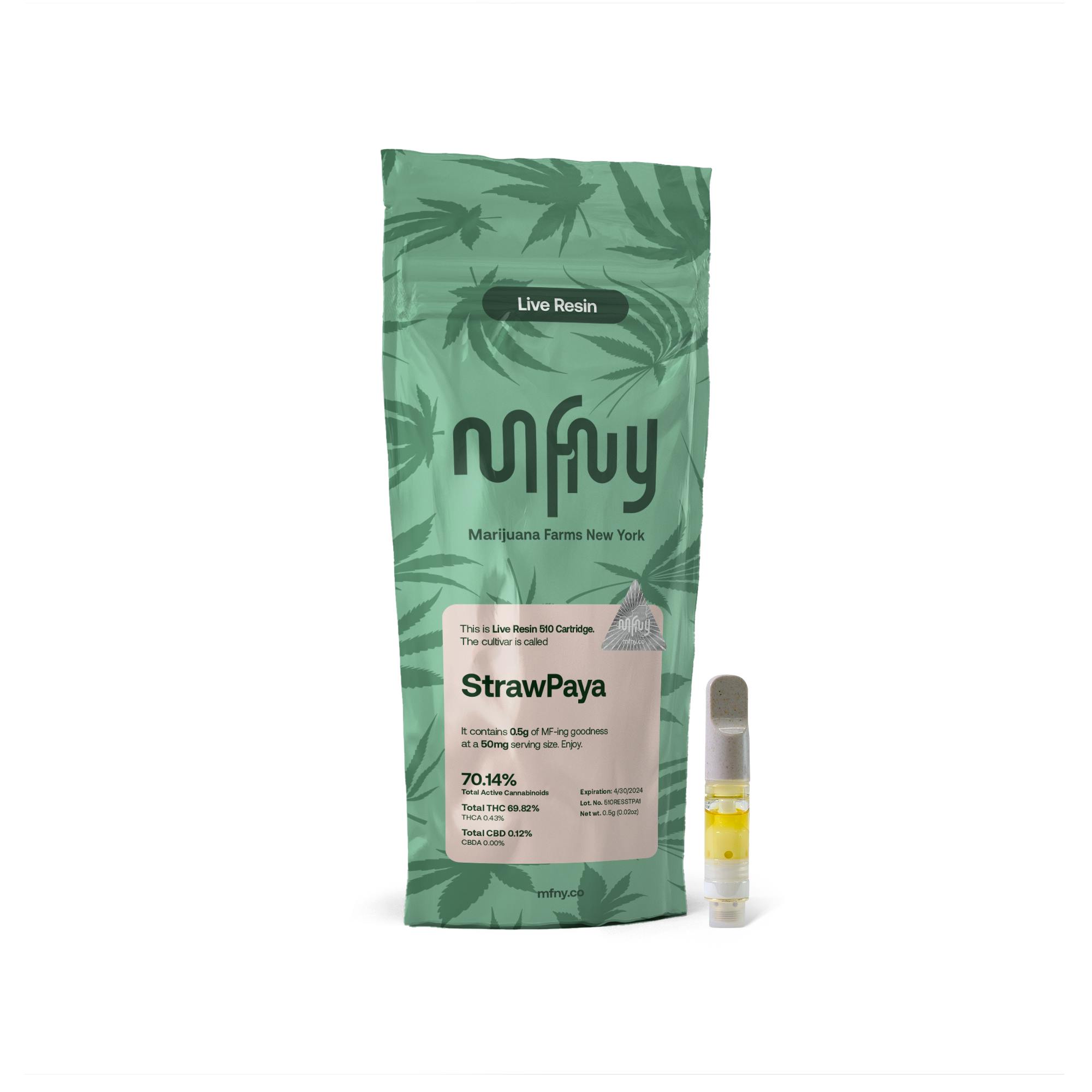
On sale· 15% OFF
THC 67.13%·CBD 0.19%Sativa
MFNYStrawPaya Live Resin 510 Cart | .5g · .5g
$32.30$38.00
$37after tax
About Strawpaya
Everything to know about Strawpaya.
Lineage & origin
Strawpaya is understood to be a cross of Strawberry Cough and a papaya-forward cultivar, most commonly cited as Papaya (sometimes referred to as Mango Papaya), though the precise breeder and formal release documentation have not been widely published in major public cannabis registries as of this writing. The lineage is plausible and well-supported by its terpene expression and growth characteristics, but consumers should note that the exact originating seed company has not been definitively confirmed across sources such as Leafly or Wikileaf. Strawberry Cough, the more storied parent, is a sativa-dominant cultivar whose own lineage is somewhat debated — Kyle Kushman is frequently credited with its popularization in the early 2000s, though the original cross is thought to involve Strawberry Fields and Haze. Strawberry Cough became a cultural touchstone in New York cannabis circles precisely for its smooth smoke, expansive cerebral quality, and distinctive berry aroma. It set a high bar for fruity sativas. Papaya, the presumed second parent, is often attributed to Nirvana Seeds and is thought to descend from Citral and Ice lineage, though this too is contested in some corners of the cultivation community. Papaya contributes density, tropical sweetness, and a grounding body warmth that tempers Strawberry Cough's more electric tendencies. The marriage of these two cultivars produces a strain that feels both buoyant and anchored — a balance that distinguishes Strawpaya from more one-dimensional fruity sativas.
Effects
Strawpaya tends to announce itself within minutes of consumption — the onset is relatively prompt, consistent with its sativa-forward architecture, and the initial impression is one of gentle cerebral brightening. Thoughts come with a quality of lightness and mild expansiveness; there is a sense of the mental landscape opening without the sharp, sometimes anxious edge that can accompany high-myrcene or terpinolene-heavy sativas. Social fluency tends to come readily at this stage. As the experience deepens into its peak — typically settling in between fifteen and forty minutes after onset, depending on consumption method and individual sensitivity — Strawpaya's body element becomes more perceptible. The Papaya lineage contributes a mild physical ease that sits beneath the cerebral current, preventing the strain from feeling untethered. The overall character is warm, curious, and gently energizing rather than stimulating in any disruptive sense. Duration is generally moderate, with most users reporting a two-to-three-hour window before gradual return to baseline. The comedown is notably smooth; there is little of the abrupt depletion that some sativas produce. Caryophyllene's mild interaction with CB2 receptors may contribute to the body ease during the latter portion of the experience, while limonene's mood-associated properties likely underpin the strain's characteristic brightness. As with any cannabis product, starting with a conservative amount and proceeding gradually is the sensible approach, particularly for those newer to sativa-dominant cultivars.
Aroma, flavor & terpenes
The aromatic profile of Strawpaya is one of its most immediate and endearing qualities. On the nose, ripe strawberry dominates — not a synthetic or candied interpretation, but something closer to a sun-warmed berry pulled from the vine. This is the signature of a myrcene and ocimene interplay: myrcene lends an earthy, slightly musky sweetness that grounds the fruit note, while ocimene provides the bright, almost floral lift that keeps the aroma from feeling heavy. Together, they produce a scent that is both familiar and quietly complex. Beneath the strawberry, a tropical undercurrent emerges — mellow papaya and a suggestion of ripe mango — which speaks directly to the Papaya parent's terpene contribution. Limonene layers in a clean citrus brightness, like the zest of a blood orange rather than anything sharp or astringent. Secondary notes of light pine, attributable to pinene, add a faint herbal backbone that prevents the profile from becoming one-dimensionally sweet. On the palate, whether smoked or vaporized, Strawpaya is smooth and generous. The inhale carries the full fruit expression, with strawberry and tropical notes at the fore. The exhale introduces a soft, almost floral finish — a quality often associated with linalool's presence, though linalool here plays a supporting rather than starring role. At lower vaporization temperatures, the fruit notes are most vivid; higher heat reveals more of the earthy, slightly spiced caryophyllene warmth on the back of the palate.
Appearance
Strawpaya's buds reflect its sativa character in their structure: they tend toward the elongated, loosely spired form typical of Haze-influenced genetics, with a moderately open calyx architecture that allows light to pass through the flower. They are not the dense, compact nuggets associated with indica-dominant cultivars, but neither are they excessively airy — a well-grown Strawpaya sits at a pleasing middle point of structure. The colour palette leans toward medium to bright green, often with warmer olive undertones that deepen near the base of each bud. Pistils — the fine hair-like structures — present in amber and burnt orange, occasionally approaching rust, and they are distributed generously across the surface. Trichome coverage is substantial for a sativa-type, giving cured flowers a frosted, slightly silvery quality under direct light. The overall visual impression is of a strain that is bright, vital, and carefully tended — an appropriate aesthetic for its fruit-forward character.
Growing notes
Strawpaya's sativa heritage means cultivators should anticipate vertical stretch during the flowering phase, making canopy management — through techniques such as low-stress training or topping — a practical consideration for indoor grows with limited ceiling height. Flowering time is reported in the range of nine to ten weeks, consistent with many sativa-leaning hybrids, and the structure of the buds means adequate airflow is worthwhile to maintain during the later flowering period. Indoor cultivation under controlled conditions allows the terpene profile to express most fully, with temperature and humidity management during late flower contributing meaningfully to final aroma quality. Outdoor grows in warm, Mediterranean-style climates — where the plant benefits from long, sunny days and moderate humidity — can yield generous harvests, though the extended season requirement limits outdoor viability in cooler climates. Yield expectations are moderate to generous indoors; outdoor plants given sufficient space and sunlight can become quite large. Strawpaya is considered an intermediate-difficulty cultivar: approachable for growers with some experience, but rewarding of attentive care.
When it's best enjoyed
Strawpaya finds its most natural expression in the hours between obligation and evening — the late afternoon window when the day's structure has relaxed but the night has not yet settled in. It is well-suited to solo creative work: writing, sketching, playing through a set of songs without an audience. The strain's clear-headed brightness supports associative thinking and the patient engagement that creative practice requires, while its mild body ease prevents restlessness from becoming the dominant note. It is also, by temperament, a social strain — unhurried conversation, a walk through a neighborhood that repays slow observation, or the early portion of a long dinner among people you like. For food pairing, the tropical and berry terpene profile aligns naturally with a composed ceviche, ripe stone fruit, or a light sparkling wine whose acidity mirrors the strain's citrus limonene thread. Musically, something in the vein of João Gilberto or a warm, melodically generous jazz record suits the mood — sound that rewards attention without demanding it. Strawpaya is, in the best sense, an accompaniment to the good parts of an ordinary day.
If you like Strawpaya, also explore
Strawberry Cough
As the primary parent cultivar, Strawberry Cough shares Strawpaya's signature berry aroma and clear-headed sativa uplift, making it the most natural reference point for fans of either strain.
Papaya
The tropical sweetness and gentle body ease of Papaya underpin Strawpaya's softer, more grounded qualities, and consumers drawn to those notes will find the parent cultivar a satisfying standalone exploration.
Tropicana Cookies
For those who appreciate Strawpaya's citrus-forward brightness and uplifting character, Tropicana Cookies offers a similarly vivid, fruit-driven sativa experience anchored by limonene and a comparable mood-elevating arc.
Mimosa
Mimosa shares Strawpaya's approachable daytime sensibility and citrus-meets-tropical aroma profile, making it a logical companion choice for consumers who favor bright, sociable, fruit-expressive cultivars.
Zkittlez
While more indica-leaning, Zkittlez appeals to the same palate that gravitates toward layered, candy-fruit terpene profiles, and those who enjoy Strawpaya's aromatic complexity often find Zkittlez a complementary evening counterpart.
Common questions
Is Strawpaya indica or sativa?+
Strawpaya is classified as a sativa-dominant hybrid. Its Strawberry Cough parent contributes the strain's characteristic cerebral uplift and clear-headed energy, while the Papaya lineage introduces a mild body warmth that softens the experience. The overall effect profile aligns more closely with what consumers associate with sativa-leaning cultivars: sociable, gently energizing, and suited to daytime or early-evening use.
What does Strawpaya taste like?+
Strawpaya tastes much as it smells: ripe strawberry is the most prominent note, followed by a tropical undercurrent of papaya and a quiet citrus brightness on the finish. There is a mild floral quality on the exhale and a subtle herbal backbone that keeps the sweetness grounded. The smoke or vapor is notably smooth, with little harshness, making the full terpene expression easy to appreciate across the consumption experience.
What are the typical effects of Strawpaya?+
Strawpaya typically produces a clear-headed, gently uplifting experience with a sociable, creatively open quality. Onset is relatively prompt, with cerebral brightness arriving first and a mild body ease settling in as the experience matures. The duration is moderate — generally two to three hours — and the comedown is smooth. The strain is considered approachable for daytime use, though individual responses vary and a conservative start is always advised.
What strains are similar to Strawpaya?+
Consumers who enjoy Strawpaya often gravitate toward Strawberry Cough for its shared berry character and uplifting sativa quality, Tropicana Cookies for its citrus-forward brightness, or Mimosa for a comparable daytime fruit-driven experience. Papaya, as the secondary parent, is also a natural companion. Zkittlez appeals to the same palate that enjoys Strawpaya's layered fruit terpene profile, though it leans indica-dominant.
Is Strawpaya good for beginners?+
Strawpaya is relatively approachable compared to some high-intensity sativas, and its smooth terpene profile makes the experience pleasant for most consumers. That said, any sativa-dominant cultivar can feel overstimulating for those unaccustomed to the category. New consumers are encouraged to start with a small amount, wait to assess the full onset before continuing, and choose a comfortable, familiar setting — ideally with no pressing obligations afterward.
What are the dominant terpenes in Strawpaya?+
Strawpaya's terpene profile is led by myrcene, which provides the earthy-sweet berry foundation, and limonene, which contributes citrus brightness and the strain's characteristic mood-associated quality. Ocimene adds a floral, tropical lift, while caryophyllene brings a mild spiced warmth and body ease in the latter portion of the experience. Pinene and linalool appear as secondary contributors, lending a soft herbal-and-floral finish to both the aroma and the palate.
When is the best time of day to consume Strawpaya?+
Strawpaya is best suited to daytime and early-evening consumption. Its sativa-dominant, clear-headed character makes it a natural fit for the late morning through mid-afternoon window, or the relaxed period between the end of the workday and dinner. It is not typically recommended as a pre-sleep cultivar given its energizing tendencies, though the Papaya lineage's grounding body quality makes it somewhat more versatile than a pure sativa in this regard.
How does Strawpaya's lineage influence its character?+
The balance between Strawberry Cough and Papaya is directly legible in Strawpaya's character. Strawberry Cough contributes the cerebral uplift, the berry-forward aroma, and the smooth, social energy the strain is known for. Papaya counterbalances with tropical sweetness, a mild physical ease, and a structural density that prevents the experience from feeling unmoored. The result is a sativa that feels both lively and composed — more nuanced than either parent in isolation.
Related strains