
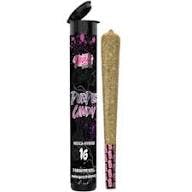
Indica-Hybrid
All strains Purple Candy
1 live products in stock
Quick answer · What is the Purple Candy cannabis strain?
Purple Candy arrives at the intersection of old-world Kush tradition and Canadian craft breeding — a visually arresting, indica-leaning hybrid whose violet-tinged buds carry the quiet promise of a long evening well spent. Sweet berry perfume mingles with an earthy undercurrent, and the experience that follows is deliberate and grounding, the kind of session that asks nothing of you except that you slow down and pay attention.
Shop Purple Candy · 1 of 1 live products
About Purple Candy
Everything to know about Purple Candy.
Lineage & origin
Purple Candy is the work of BC Bud Depot, a British Columbia–based seed company that has long built its reputation around cold-climate, trichome-heavy cultivars. The strain is generally documented as a cross of Sweet Tooth — itself a Barney's Farm creation and a three-time High Times Cannabis Cup winner in the early 2000s — and Candyland's grandfather stock, though several sources more precisely cite the second parent as BC Bud Depot's own in-house Purple Afghan or a related Afghani-dominant purple phenotype. The exact pedigree is not fully disclosed by the breeder, and some genetic databases list the lineage with a noted caveat that the second parent is debated. Sweet Tooth's contribution is significant: it brought a demonstrably sweet, candy-forward aromatic character and a relatively compact, resinous bud structure bred for northern latitudes. The Afghani or Purple Afghan parentage delivers the indica lean, the propensity for deep purple coloration under cool temperatures, and the body-forward effect profile that defines the finished plant. Purple Candy emerged from the mid-2000s Canadian craft scene, a period when BC Bud Depot was actively popularizing purple-expressing, cold-weather cultivars for both domestic and international markets. It occupies genetic territory similar to BC Bud Depot siblings like Purple Kush and Purple Urkle crosses, sharing the family's signature color expression and resin-focused phenotype selection.
Effects
The onset of Purple Candy is generally measured — most consumers report feeling the first wave within ten to fifteen minutes of inhalation, a gentle cerebral warmth that softens focus without eliminating it. This early phase carries a quiet uplift, mild mood elevation that feels less like stimulation and more like the easing of ambient tension. It is an effect profile consistent with the limonene and myrcene interplay often documented in this cultivar. As the session deepens, the indica lineage asserts itself. The body sensation broadens and settles, moving from the shoulders downward, lending a physical ease that pairs naturally with stillness. Peak character is primarily somatic — a weighted, comfortable relaxation that anchors rather than incapacitates at moderate consumption. The cerebral component does not vanish but recedes to a pleasant, unhurried background hum. This phase typically sustains for ninety minutes to two hours depending on individual tolerance and consumption method. The comedown is gradual and gentle, the experience tapering into drowsiness rather than dropping abruptly. Dry mouth and dry eyes are among the most commonly reported side effects, and the sedative quality that characterizes the final hour makes Purple Candy a strain many consumers associate with evening rather than midday use. Those newer to cannabis are well advised to start low and go slow, as the body effect can deepen quickly with higher consumption.
Aroma, flavor & terpenes
The aromatic profile of Purple Candy is one of its most immediately compelling attributes. The dominant terpene in most tested phenotypes is myrcene, which contributes the warm, slightly musky, overripe-berry quality that gives this cultivar its name-appropriate sweetness. Myrcene is also associated with the muscle-easing, sedative undertone that runs beneath the surface of every session, making its prominence here both sensory and functional. Caryophyllene, the sole terpene known to interact directly with CB2 receptors, registers as a faint spiced woodiness — think cracked black pepper or dried clove — that adds structural depth and prevents the sweetness from reading as one-dimensional. Limonene contributes a citrus brightness, a thread of tangerine or lemon zest that lifts the mid-note and is thought to contribute to the mild mood-brightening quality of the early effect arc. Some phenotypes express notable linalool, lending a subtle floral, almost lavender register that harmonizes with the berry character and may contribute to the strain's calming finish. On the palate, Purple Candy smokes or vaporizes with a smooth, rounded sweetness on the inhale — grape candy and wild berry, occasionally with a mild stone-fruit nuance. The exhale is earthier, warmed by the caryophyllene spice note and a light hashy finish consistent with its Afghani heritage. The smoke is generally described as full-bodied and not particularly harsh, provided material is well-cured.
Appearance
Purple Candy produces dense, tightly packed buds characteristic of its indica-dominant architecture. Calyxes are compact and stacked, forming elongated clusters that feel substantial in the hand. The most striking feature is, predictably, the coloration: under cooler curing or growing temperatures, anthocyanin pigments express in deep violet, indigo, and muted plum throughout the leaves and sugar leaves, set against a backdrop of forest green that varies by phenotype and grow conditions. Pistils — the hair-like reproductive structures — range from burnt orange to deep amber at maturity, creating a warm contrast against the cool purple tones. Trichome coverage is generous, reflecting Sweet Tooth's resin-forward genetics; the buds carry a frosted, almost silvered appearance under direct light, with glandular heads dense enough to lend a tactile stickiness to well-dried material. The overall visual impression is one of depth and richness, a bud that earns its premium-shelf positioning through structural integrity and chromatic distinction.
Growing notes
Purple Candy is considered a moderately approachable cultivar for home growers with some prior experience, though it is not typically recommended as a first-time project given its sensitivity to humidity and temperature management. BC Bud Depot bred this strain with northern climates in mind, meaning it performs reliably in cooler environments — a trait that is also responsible for the anthocyanin expression that deepens purple coloring in the final weeks of flower. Indoors, Purple Candy flowers in approximately eight to nine weeks and produces moderate to above-average yields when trained with low-stress or screen-of-green methods. Outdoors, it is best suited to temperate climates where nighttime temperatures drop in late summer, both to protect against mold — to which dense indica bud structures are inherently susceptible — and to encourage the color development the strain is prized for. Outdoor harvest typically falls in early to mid-October in the Northern Hemisphere. The plant grows to a manageable height indoors, staying compact with modest lateral branching, which makes it well suited to smaller grow spaces.
When it's best enjoyed
Purple Candy is, at its core, an evening strain — one that suits the hour after the day's obligations have concluded and before sleep becomes the only remaining agenda item. It belongs to quiet domestic rituals: the last record of the night played at low volume, a slow dinner with close company, a long bath with a book that makes no demands on concentration. Its body-forward, gently sedative character makes it a natural companion to deceleration rather than inspiration. On the table, Purple Candy pairs thoughtfully with foods that echo its terpene profile — a cheese board anchored by aged gouda or soft brie alongside dark stone-fruit preserves, or a simple dark chocolate with a high cacao percentage that mirrors the earthy-sweet finish on the exhale. Musically, the strain's character aligns with slow-tempo, textural work: late-period Bill Evans, low-key soul, or the more meditative end of ambient electronica. It is, in short, a strain for presence rather than productivity — for the cultivated art of doing very little, very well.
If you like Purple Candy, also explore
Purple Kush
A fellow indica-dominant, Afghani-lineage cultivar with comparable deep grape and earthy aromatics and a similarly sedative, full-body effect arc — a natural next exploration for Purple Candy enthusiasts.
Granddaddy Purple
Ken Estes's Californian classic shares the berry-grape terpene profile, anthocyanin-driven visual appeal, and the progressive body relaxation that Purple Candy fans gravitate toward.
Sweet Tooth
As one of Purple Candy's parent strains, Sweet Tooth delivers familiar candy-sweet aromatics in a slightly more balanced, less sedative package — useful for daytime exploration of the same flavor family.
BC God Bud
Another BC Bud Depot flagship, BC God Bud shares the dense bud structure, resinous finish, and deep physical relaxation characteristic of the breeder's indica-leaning catalog.
Purple Urkle
An older West Coast cultivar with contested lineage, Purple Urkle mirrors Purple Candy's grape-forward nose, indica-dominant effect profile, and evening-session suitability.
Common questions
Is Purple Candy indica or sativa?+
Purple Candy is classified as an indica-leaning hybrid. Bred by BC Bud Depot from Sweet Tooth and an Afghani-dominant purple parent, it expresses a primarily body-focused effect profile with a mild cerebral opening phase. While it carries some hybrid balance in its early onset, the experience tilts decidedly toward physical ease and eventual sedation, placing it firmly in the evening-use category for most consumers.
What does Purple Candy taste like?+
Purple Candy delivers a rounded, sweet berry and grape flavor on the inhale — candy-forward but grounded, not artificial. The exhale brings in earthier notes: light hash, faint spiced wood from caryophyllene, and occasionally a subtle floral finish attributed to linalool. The overall palate impression is smooth and full-bodied, with the sweet and earthy registers balancing each other across a well-cured sample.
What are the typical effects of Purple Candy?+
Consumers typically describe a gentle cerebral warmth at onset, characterized by mild mood elevation and a quiet easing of tension. As the session progresses, the indica parentage asserts itself in the form of broad, weighted physical relaxation. The experience is generally described as calming and grounding, with a gradual comedown into drowsiness. It is not commonly associated with energetic or creative output, making it a natural fit for evening use.
What strains are similar to Purple Candy?+
Consumers drawn to Purple Candy's grape-forward aromatics and sedative body effect often enjoy Granddaddy Purple, Purple Kush, and Purple Urkle for similar sensory and experiential profiles. Sweet Tooth, as a parent strain, offers a comparable sweetness with a lighter body effect. BC God Bud, another BC Bud Depot cultivar, shares the breeder's resin-heavy, indica-leaning character and is worth exploring for fans of the house style.
Is Purple Candy good for beginners?+
Purple Candy can be approachable for adults new to cannabis, but the indica-dominant body effect and sedative finish deserve respect. The experience can deepen more quickly than expected, particularly at higher consumption volumes. Anyone new to cannabis is encouraged to start with a very modest amount, allow adequate time between sessions to gauge individual response, and choose a comfortable, familiar setting. Dry mouth and dry eyes are the most commonly noted side effects to be aware of.
What are the dominant terpenes in Purple Candy?+
Myrcene is the most consistently prominent terpene in Purple Candy, contributing its characteristic musky berry sweetness and sedative undertone. Caryophyllene follows, lending a spiced, woody depth to the aromatic profile. Limonene provides a citrus brightness that softens the heavier notes, while linalool — present in some phenotypes — adds a mild floral quality. Together, these terpenes create a layered, sweet-earthy nose with gentle complexity.
When is the best time of day to consume Purple Candy?+
Purple Candy is most at home in the evening hours. Its progressive body-forward effect arc and sedative comedown make it less suited to morning or midday sessions when alertness and productivity are priorities. It is well matched to the transitional hours between late afternoon and bedtime — dinner, quiet leisure, or the winding-down rituals that prepare the mind and body for rest. Daytime consumption is entirely a personal choice, though its sedative character should be factored in.
Who bred Purple Candy and where does it come from?+
Purple Candy was developed by BC Bud Depot, a seed company based in British Columbia, Canada, with a long-standing reputation for cold-climate, purple-expressing indica cultivars. The strain is documented as a cross involving Sweet Tooth — a Barney's Farm creation and multiple Cannabis Cup winner — and an Afghani-dominant purple parent, though the breeder has not publicly specified every detail of the lineage. It emerged from the mid-2000s Canadian craft cannabis scene.
Related strains