THC 89.1%Indica-Hybrid
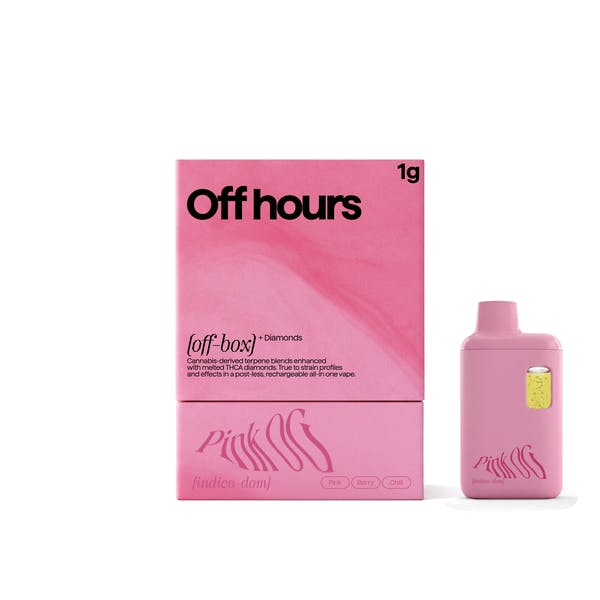
Off HoursOff hours - Box All-in-one Liquid Diamonds Vape Pen (Pink OG) · 1g
$33.63
$38after tax

weeddispensarynearme.com
You must be 21 years or older to enter. By entering, you confirm you’re of legal age in your state to purchase cannabis.
For use only by adults 21+ • Keep out of reach of children
1 live products in stock
Quick answer · What is the Pink OG cannabis strain?
Pink OG arrives with the quiet confidence of a strain that has earned its reputation through experience rather than spectacle. A warm, floral embrace underpins its classic OG foundation, yielding a session that is as composed as it is deeply relaxing. Soft rose and vanilla notes drift through dense, trichome-laden buds, signaling an indica-leaning profile suited to those who prize evening ease, thoughtful stillness, and the gentle dissolution of a long day's accumulated tension.
$38after tax
About Pink OG
Pink OG is generally attributed to crossing Pink Kush with OG Kush, two of the most celebrated and widely studied lineages in contemporary cannabis culture. Pink Kush itself carries a disputed ancestry — most sources agree it is an OG Kush phenotype or close descendant that emerged from the British Columbia cannabis scene in the early 2000s, where it was selected for its unusually floral, candy-like aromatics and pronounced body effect. OG Kush, the other parent, traces its own complex lineage to the early 1990s California scene, widely believed to involve Chemdawg, Hindu Kush, and Lemon Thai genetics, though its precise origins remain a subject of ongoing debate among breeders and historians alike. The specific breeder responsible for stabilizing Pink OG as a named cultivar has not been consistently documented across public cannabis databases, and multiple regional seed banks and craft cultivators have produced cuts marketed under this name. This is not unusual for strains with such desirable parent genetics — when two beloved cultivars cross paths, regional phenotype hunters and micro-breeders often work in parallel, producing similar but not identical expressions. The result is a strain that can show meaningful variation across different sources, though the core profile — dense OG structure, floral sweetness, heavy-bodied effect — remains recognizable. Enthusiasts of other OG-adjacent hybrids such as Tahoe OG or Fire OG will find the genetic architecture here familiar.
The onset of Pink OG tends to present itself within five to fifteen minutes of inhalation, beginning with a mild cerebral warmth that softens the edges of conscious thought without fully retreating into sedation. This initial phase has a gently euphoric quality — a quiet lift that encourages introspection and a measured sense of well-being. It rarely produces the racing mental activity associated with more sativa-forward cultivars; rather, the mind settles into a comfortable, unhurried rhythm. As the session progresses into its peak, typically between thirty and ninety minutes in, the indica character asserts itself with increasing clarity. A progressive body relaxation moves from the shoulders downward, releasing muscular tension and encouraging a deep, physical ease. The dominant terpene myrcene is understood to contribute to this sedative, muscle-softening character, while caryophyllene may lend a grounding quality to the overall experience. Linalool, when present in meaningful concentrations, amplifies the calming, almost ceremonial quality of the peak. The comedown is notably gentle — Pink OG does not tend to drop users abruptly but instead transitions gradually into a restful, drowsy state. For those new to cannabis or to indica-leaning hybrids in particular, the standard guidance applies: start with a modest amount and allow adequate time before reassessing. Duration of the primary experience typically ranges from two to three hours, with residual relaxation extending somewhat beyond that window.
Pink OG's aromatic identity is one of its most compelling characteristics, setting it apart from the more fuel-forward expressions typical of many OG Kush descendants. The nose opens with a distinct floral sweetness — rose petal and light vanilla — that reflects the Pink Kush heritage and is likely tied to elevated linalool content, a terpene associated with lavender-like, calming floral notes. Beneath this soft opening, the unmistakable earthiness of myrcene grounds the profile, introducing a damp, herbal depth reminiscent of fresh soil after rain. Secondary terpenes add further dimension. Caryophyllene contributes a faint spice — a dry, peppery warmth that prevents the sweetness from becoming cloying — while traces of pinene introduce a subtle, resinous brightness not unlike a distant pine forest. Some phenotypes express a mild citrus undercurrent, potentially attributable to limonene, which integrates quietly into the floral and earth composition rather than announcing itself. On the palate, Pink OG smokes with a creamy, full-bodied character. The floral sweetness carries through the inhale, while the exhale tends to deliver a smooth earthiness with a light, lingering sweetness on the back of the throat. Vapor production via dry-herb vaporizer tends to accentuate the floral and vanilla notes, making lower-temperature sessions particularly expressive of the Pink Kush parentage. The smoke is rarely harsh when flower is properly cured, finishing clean and with a pleasant, faintly sweet aftertaste.
Pink OG produces buds of notable density — compact, tightly wound calyxes that reflect the structural influence of its OG Kush lineage. The overall bud architecture leans toward medium to large, rounded formations rather than the elongated, spear-like structure of more sativa-influenced cultivars. Trichome coverage is generous, lending a frosted, almost silvery luminescence to the surface of well-grown specimens that speaks to the resin production typical of both parent strains. The color palette is one of the strain's most visually distinctive qualities. A deep forest green forms the base, against which curling amber and rust-orange pistils thread with characteristic abundance. In certain phenotypes and under cooler late-flowering temperatures, faint violet or lavender hues may emerge within the deeper recesses of the bud — a trait that can be traced to the Pink Kush side of the lineage. The overall presentation is lush and considered, the kind of flower that rewards a slow, close examination before the session begins.
Pink OG is cultivated both indoors and outdoors, though indoor environments offer growers the greatest control over the conditions that bring out this cultivar's most expressive qualities. Flowering time typically falls in the range of eight to nine weeks when grown under a controlled light cycle, which is consistent with the OG Kush family's general schedule. Yields are described as moderate to generous across reputable grow reports, with indoor harvests rewarding patient cultivators who invest in proper canopy management. The strain is considered moderately challenging — not ideally suited to first-time home cultivators, as the dense bud structure that makes Pink OG visually striking also increases susceptibility to humidity-related issues, including botrytis, if airflow and environmental controls are not carefully maintained. Outdoor cultivation is feasible in temperate, Mediterranean-style climates with reliable late-summer warmth. For the cultivator-curious shopper, it is worth noting that the strain's pink and violet color expressions are typically coaxed by cooler nighttime temperatures in the final weeks of flowering — a detail that speaks to the attentive craftsmanship quality flower demands.
Pink OG is, at its core, an evening companion — a strain calibrated for the hours after the day's obligations have been set aside and intentional rest begins. Its indica-leaning effect profile makes it a thoughtful choice for solo wind-down rituals: a quiet hour with a book, a slow bath, or an unhurried conversation with a trusted friend in a calm setting. The floral, earthy aromatics pair with an atmosphere of deliberate ease. For those who find pleasure in pairing their cannabis sessions with music, the warm, rounded character of Pink OG aligns naturally with ambient or neo-soul recordings — artists whose sound occupies the same unhurried, textural space the strain inhabits. On the culinary side, the vanilla and floral notes in the terpene profile find a pleasant complement in mild, aromatic foods: a soft cheese board with honey and dried fruit, or a light herbal tea served warm. This is not a strain designed for high-energy social occasions or demanding creative sprints; it is suited instead to the kind of evening that deserves to be experienced slowly and without interruption.
Pink Kush
As one of Pink OG's direct parent strains, Pink Kush shares the floral sweetness, linalool-forward aromatics, and deeply relaxing body effect that define the Pink OG experience.
OG Kush
The foundational OG lineage is immediately recognizable in Pink OG's dense bud structure, earthy pine base, and grounding cerebral onset, making it a natural reference point for OG enthusiasts.
Tahoe OG
Tahoe OG's heavy, sedating body effect and earthy, lemon-fuel profile appeal to the same palate that gravitates toward Pink OG's composed, indica-leaning depth.
Bubba Kush
Bubba Kush shares Pink OG's dense structure, sweet earthiness, and the gentle, full-body relaxation that makes both strains well-suited to contemplative evening sessions.
Purple OG Kush
Purple OG Kush offers a comparable floral-meets-OG-earth profile with similar violet color expressions and a calming, indica-forward effect arc that Pink OG fans will find familiar.
Pink OG is an indica-leaning hybrid, meaning it carries characteristics of both cannabis classifications but tilts meaningfully toward the body-focused, relaxing qualities associated with indica genetics. Its parentage — Pink Kush and OG Kush — are both indica-dominant cultivars, which informs the strain's dense bud structure, floral earthiness, and progressively sedating effect arc. It is generally regarded as better suited to evening than daytime use.
Pink OG offers a distinctive and layered flavor profile anchored by floral sweetness — rose petal and soft vanilla on the inhale — followed by a smooth, earthy exhale with a faint peppery warmth contributed by caryophyllene. Some phenotypes express a light citrus undercurrent. The overall palate impression is creamy and rounded, finishing with a mild sweetness that lingers pleasantly. Vapor at lower temperatures tends to highlight the floral notes with particular clarity.
Pink OG typically produces a gentle cerebral warmth at onset — a soft, euphoric ease that gradually gives way to a pronounced body relaxation. The experience is calming rather than energizing, with the indica character becoming more prominent as the session progresses. Most users describe a quiet, restful feeling well-suited to evening use. The comedown is gradual, often transitioning into drowsiness. As always, those new to this cultivar are encouraged to start low and go slow.
Consumers who appreciate Pink OG tend to enjoy Pink Kush for its shared floral sweetness and deep body relaxation, OG Kush for its foundational earthy character, and Bubba Kush for its comparable density and calm, sedating profile. Tahoe OG and Purple OG Kush are also frequently cited as kindred cultivars, each offering the grounding, indica-forward experience that defines the broader OG family to which Pink OG belongs.
Pink OG can be approachable for beginners who prefer a calming, body-focused experience, but its indica-leaning potency warrants some caution. The effect arc moves progressively toward sedation, which can feel more intense than expected for those unaccustomed to OG-lineage cultivars. New consumers are advised to follow the standard approach: start with a small amount, allow sufficient time — at least thirty minutes — to assess the effect before consuming more, and choose a comfortable, low-commitment setting.
Pink OG's terpene profile is typically led by myrcene, which contributes its earthy, herbal depth and is associated with the strain's relaxing body quality. Linalool is also prominent, accounting for the distinctive floral, rose-like sweetness inherited from the Pink Kush lineage. Caryophyllene adds a dry, spicy warmth that balances the sweetness, and secondary contributions from pinene and occasional limonene round out the profile with resinous brightness and mild citrus respectively.
Pink OG is best positioned as an evening or late-afternoon cultivar. Its indica-leaning effect profile — progressive body relaxation, a calming cerebral tone, and a gentle drift toward drowsiness — makes it less suited to mornings or periods requiring sustained focus or physical coordination. It performs at its best when the day's demands have concluded and the goal is intentional rest, quiet reflection, or an unhurried social experience in a low-key setting.
Yes — Pink OG is visually compelling within the OG family. Dense, rounded buds with heavy trichome coverage give it a frosted appearance, while rust-orange pistils thread prominently through a deep green base. In phenotypes exposed to cooler late-flowering temperatures, faint lavender or violet hues can emerge within the bud, a trait tied to the Pink Kush lineage. Well-cured Pink OG flower has a lustrous, resinous quality that reflects attentive cultivation and handling.
Related strains
Pick your store
We'll show pricing, deals, and delivery zones for the store you pick. You can switch any time from the header.