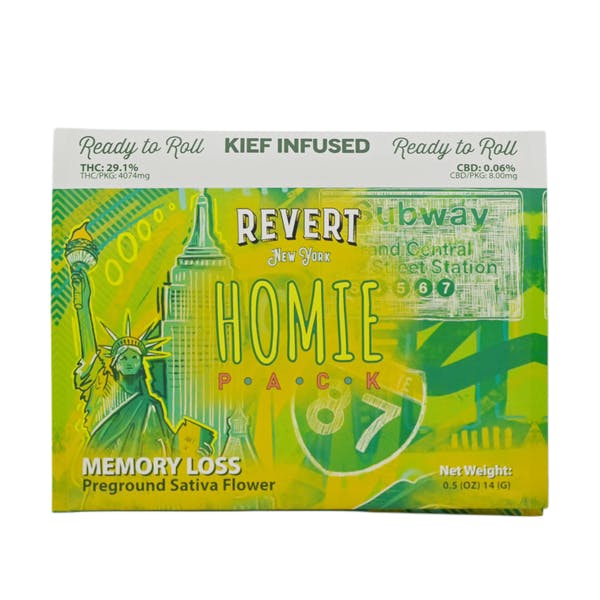
THC 29.1%Sativa
Revert CannabisRevert Kief Infused Pre Ground Flower Memory Loss Homie Pack · 14g
$50.44
$57after tax

weeddispensarynearme.com
You must be 21 years or older to enter. By entering, you confirm you’re of legal age in your state to purchase cannabis.
For use only by adults 21+ • Keep out of reach of children
1 live products in stock
Quick answer · What is the Memory Loss cannabis strain?
Memory Loss arrives with an apt name and a reputation that precedes it across the Pacific Northwest and beyond. A fast-flowering, high-energy sativa from Archive Seed Bank, it delivers a clear-headed, almost euphoric lift that can feel disorienting in the most pleasurable sense — a gentle dissolution of the day's accumulated noise. The aroma alone, a bright collision of citrus, pepper, and fresh earth, signals that this is a strain worth approaching with considered intention.
$57after tax
About Memory Loss
Memory Loss is the work of Archive Seed Bank, a Portland, Oregon-based seed company recognized for meticulous phenotype selection and a catalogue heavy with sativa-dominant expressions. The strain's parentage is documented as a cross between Amnesia Haze and a Face Off OG male, though some community sources suggest the Face Off OG contribution leans heavily on Archive's own keeper cuts of that variety. Amnesia Haze itself carries a storied, multi-generational lineage tracing back to Haze, Jamaican, Hawaiian, and South Asian landrace genetics, along with influence from Afghani and possibly Skunk. It became a fixture of Amsterdam's coffee-shop culture and won the High Times Cannabis Cup in 2004. Face Off OG brings the more grounded, resinous West Coast OG Kush character into the cross, adding structural density and contributing to the notably short flowering window — remarkable for a sativa of this profile. Released in the early-to-mid 2010s, Memory Loss gained traction quickly on the competition circuit, earning recognition at the High Times Cannabis Cup and becoming one of Archive's most sought-after catalog entries. Closely related strains include other Archive sativa projects, and its Amnesia Haze parentage places it in a broad genetic family that includes Amnesia, Amnesia Lemon, and various Haze hybrids popular across European and North American markets.
The onset of Memory Loss tends to be notably swift by sativa standards, often registering within five to ten minutes of inhalation as a warm pressure behind the eyes that quickly opens into a broad, luminous mental clarity. The initial phase is cerebral and activating — thoughts accelerate, sensory perception sharpens, and conversation flows with an ease that can feel almost surprising. This is not a sedating experience; the body remains functional and light, and many people report a gentle physical warmth rather than heaviness. At peak, the experience is primarily held in the mind: a quality of expansive focus that can tip into mild euphoria without the anxious edge that sometimes accompanies high-THC sativas. The terpene profile plays a meaningful role here — terpinolene is associated in the literature with uplifting, sometimes dreamy effects, while myrcene's modest presence rounds the edges without pulling toward sedation. Duration is typically two to three hours for most consumers, with a gentle, gradual comedown that avoids the abrupt drop sometimes associated with purely cerebral varieties. As effects wind down, a mild relaxation settles through the body without compelling sleep. Given the pronounced potency this strain is known for, standard harm-reduction guidance applies: begin with a single, measured dose and allow adequate time before re-dosing, particularly for those newer to high-THC sativa expressions.
The terpene architecture of Memory Loss is shaped most prominently by terpinolene, a monoterpene that appears with relative rarity as a dominant compound but is characteristic of many classic Haze-derived genetics. Terpinolene delivers a complex aromatic signature: floral and herbaceous at the top, with a piney freshness underneath and a faint fruity quality sometimes described as reminiscent of apple peel or light citrus. Its presence gives Memory Loss a distinctly bright, almost electric quality on the nose that distinguishes it from the earthier, more caryophyllene-forward profiles of many contemporary hybrids. Ocimene, another terpene relatively uncommon in dominant quantities, adds a sweet, green, slightly woody dimension that weaves through the citrus register — experienced cultivators often describe it as lending a kind of herbaceous vivacity. Myrcene appears as a secondary terpene, contributing the warm, faintly musky earthiness that grounds the profile and prevents it from reading as purely sharp or synthetic. Caryophyllene rounds the composition with a subtle spice — a mild black pepper note perceptible mostly on the exhale. On the palate, Memory Loss tends to smoke cleanly, with a light, smooth draw that opens with the citrus-floral brightness noted on aroma and finishes with an earthy, faintly spiced warmth. Vapor at lower temperatures can accentuate the terpinolene-driven floral quality, making this a strain particularly well-suited to a quality dry-herb vaporizer for those wishing to explore its aromatic complexity.
Memory Loss produces buds of moderate-to-high density — firmer than many elongated sativas but without the compressed, brick-like structure of an OG-dominant hybrid. The calyx arrangement reflects its Haze heritage: slightly elongated, loosely stacked flowers that taper into modest spires rather than forming tight, spherical colas. The color palette sits in a range of medium to deep green, occasionally showing lighter, almost sage-toned highlights, with rust-orange to amber pistils winding generously through the structure. Trichome coverage is notably heavy for a sativa expression — a hallmark of the Face Off OG contribution — giving well-cured flower a frosted, almost glassy appearance under direct light. The resin density is one of the strain's most discussed physical characteristics, and it becomes immediately apparent when the flower is broken apart, releasing the terpinolene-dominant aroma in full.
Memory Loss is frequently cited as an atypically fast-finishing sativa, a quality that has made it attractive to licensed cultivators working with tight production cycles. Indoor flowering time is typically documented in the range of seven to nine weeks — shorter than many Haze-derived strains, which can stretch well past twelve weeks. This speed is attributed to the Face Off OG parentage, which introduces a degree of indica-influenced timing without substantially altering the sativa character of the finished product. Yields indoors are considered above average, and the plant responds well to low-stress training techniques to manage its vertical stretch during the transition to flowering. Outdoors, it performs best in temperate to warm climates with consistent sun and moderate humidity; the early finish is an advantage for growers in regions where autumn arrives quickly. For the cultivator-curious shopper, it is worth noting that this is generally regarded as a moderately demanding strain — its Haze genetics require environmental attentiveness, particularly around humidity management to protect the dense trichome layer during late flowering. Archive Seed Bank has made both regular and feminized seed versions available through their catalog.
Memory Loss occupies a particular niche for the daytime or early-evening consumer who wants mental engagement without sedation. It is well-suited to mornings with open schedules — a slow weekend with an art project underway, a long walk through a neighborhood worth examining closely, or an afternoon of reading that rewards sustained attention. The terpinolene-forward profile aligns naturally with activities that benefit from heightened sensory awareness and a loosening of habitual thought patterns. In a social setting, it can contribute to the quality of conversation at a small gathering, particularly where the group shares an interest in music, food, or creative work. For pairing: the citrus and floral aromatic register of Memory Loss harmonizes pleasantly with dishes that echo those qualities — a ceviche with bright acidity, a yuzu-dressed salad, or a well-made gin cocktail that carries its own botanical complexity. On the music side, long-form, texturally rich recordings — ambient works by artists such as Brian Eno, or the more expansive passages of West African guitar-led music — complement the strain's tendency to slow and widen perception without anchoring the listener in any particular emotional weight.
Amnesia Haze
As a direct parent of Memory Loss, Amnesia Haze offers the same terpinolene-driven citrus brightness and clear, cerebral sativa elevation, making it the most natural point of comparison for anyone curious about the lineage.
Ghost Train Haze
A fellow high-energy, Haze-influenced sativa with a similarly potent cerebral profile and a terpene character that skews floral and citrus-forward, Ghost Train Haze appeals to the same consumer seeking focused, daytime activation.
Durban Poison
Durban Poison shares the terpinolene-dominant terpene architecture and clean, uplifting effect profile that defines Memory Loss, offering a slightly earthier, anise-tinged take on the same general experience.
Jack Herer
Jack Herer's Haze-forward genetics and reputation for creative, clear-headed elevation make it a reliable alternative for consumers drawn to Memory Loss's energizing character and aromatic complexity.
Golden Goat
Golden Goat's spicy-tropical aroma, terpinolene presence, and uplifting, socially engaging effect profile position it as a complementary option for those who respond well to the Memory Loss experience.
Memory Loss is classified as a sativa-dominant strain. It was bred by Archive Seed Bank using Amnesia Haze — itself a multi-generational sativa lineage rooted in Haze, Hawaiian, and Jamaican genetics — crossed with a Face Off OG male. The resulting plant expresses primarily sativa character in both its growth structure and its effect profile, despite the modest indica influence from the OG parent that helps shorten the flowering window.
Memory Loss delivers a flavor profile anchored in bright citrus and floral notes, shaped largely by dominant terpinolene and secondary ocimene. The inhale tends to be light and clean, carrying a fruit-forward, herbaceous quality. The exhale introduces a mild earthiness from myrcene and a faint spiced warmth from caryophyllene. Consumers often describe the overall impression as fresh and aromatic rather than heavy, with the floral citrus character most apparent at moderate temperatures.
The effects are predominantly cerebral and activating. Onset is relatively swift, progressing into a clear-headed, euphoric mental lift with heightened sensory awareness and ease of focus. The body remains light and functional throughout the experience. Peak effects can carry a dreamy, expansive quality — partly a signature of the terpinolene and Haze genetics — and the experience typically spans two to three hours before tapering into mild physical relaxation without heavy sedation.
Consumers who appreciate Memory Loss often gravitate toward other terpinolene-forward or Haze-derived sativas. Amnesia Haze is the closest genetic relative and shares the same luminous, citrus-driven profile. Ghost Train Haze, Jack Herer, Durban Poison, and Golden Goat each offer comparable daytime, cerebral elevation with aromatic profiles that share terpene overlap. All five represent worthwhile reference points for understanding where Memory Loss sits within the broader sativa landscape.
Memory Loss is generally considered better suited to consumers with some prior experience with cannabis, particularly with high-THC sativa varieties. Its potency is well-documented, and the pronounced cerebral activation can feel intense or disorienting for those unaccustomed to strong sativa effects. For anyone newer to cannabis or to sativa-dominant strains specifically, standard harm-reduction guidance applies: start with a modest amount, allow sufficient time to assess the effects, and choose a comfortable, low-pressure setting.
Terpinolene is the defining dominant terpene in Memory Loss, contributing its characteristic floral, piney, and lightly fruity aromatic signature — a profile less common than myrcene or caryophyllene dominance in contemporary hybrids. Ocimene appears as a notable secondary terpene, adding sweet, green, herbaceous complexity. Myrcene and caryophyllene round out the profile in supporting roles, providing earthy grounding and mild spice respectively. This terpene architecture is consistent with the strain's Amnesia Haze heritage.
Memory Loss flowers in approximately seven to nine weeks indoors — a notably compact window for a sativa-dominant strain of its caliber. The shortened cycle is largely credited to the Face Off OG contribution in its genetics, which introduces a degree of OG Kush-influenced timing. This makes it more accessible for cultivators who find the extended twelve-plus-week cycles of many pure Haze varieties impractical, while retaining the essential sativa character in aroma, effect, and plant structure.
Memory Loss was developed by Archive Seed Bank, a Portland, Oregon-based breeder with a well-regarded catalog of sativa-dominant and OG-influenced genetics. Archive is known for rigorous phenotype selection and has produced a number of competition-recognized strains. Memory Loss is among their most recognized releases, having earned placement at the High Times Cannabis Cup and maintained consistent demand since its introduction in the early-to-mid 2010s. Archive offers the strain in both regular and feminized seed formats.
Pick your store
We'll show pricing, deals, and delivery zones for the store you pick. You can switch any time from the header.