THC 0.14%ONE_TO_ONE
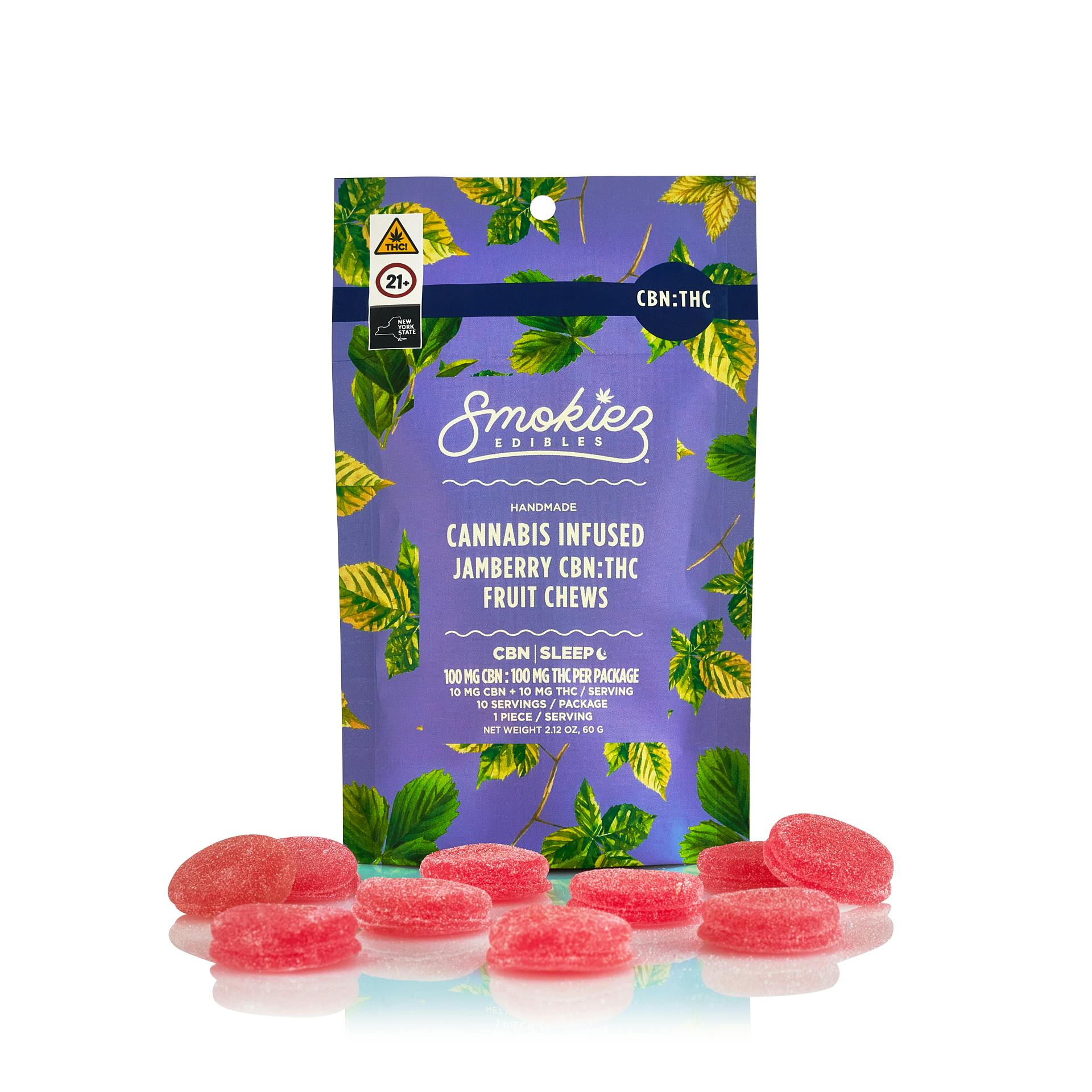
Smokiez EdiblesCBN:THC 1:1 Jamberry 100mg CBN:100mg THC Fruit Chews · .1g
$23.00
$26after tax

weeddispensarynearme.com
You must be 21 years or older to enter. By entering, you confirm you’re of legal age in your state to purchase cannabis.
For use only by adults 21+ • Keep out of reach of children
1 live products in stock
Quick answer · What is the Jamberry cannabis strain?
Jamberry arrives like a summer afternoon preserved in resin — ripe berries, subtle earthiness, and a rounded warmth that settles without demanding attention. A strain that rewards patience, its layered fruit profile and gently euphoric character make it a compelling choice for those who appreciate cannabis with a distinct sense of place and personality. Cultivated with care, Jamberry is the kind of flower that earns a second look.
$26after tax
About Jamberry
Jamberry's precise genetic lineage is not uniformly documented across public cannabis databases, and the breeder has not made a single authoritative statement about its full parentage. The consensus among platforms such as Leafly and Wikileaf points to Jamberry being a hybrid that draws from berry-forward landrace and hybrid stock, likely incorporating genetics from the broader Blueberry family — a lineage famously developed by DJ Short beginning in the late 1970s and refined through the 1980s using Thai, Purple Thai, and Afghani parents. Some phenotype discussions also suggest influence from strains in the Haze family, which would account for occasional reports of cerebral lift alongside its characteristic fruit-forward body. The strain appears to have gained traction within the Pacific Northwest cultivation scene before spreading to East Coast markets, a path common among boutique berry hybrids of its generation. Its relative obscurity compared to commercial juggernauts has, paradoxically, cultivated a devoted following among connoisseurs who seek out expressive, terroir-driven flower rather than mass-produced consistency. Genetic siblings or phenotypic cousins in the broad berry-hybrid category — strains like Blueberry, Berry White, and Blue Cheese — share some aromatic DNA, though Jamberry tends to present a fresher, more jam-like sweetness rather than the damp, fermented quality found in older Blueberry phenotypes. Until the originating breeder provides clearer documentation, some lineage details remain open to interpretation.
Jamberry typically opens with a relatively gentle onset, often noticeable within five to ten minutes when smoked or vaped, though individual metabolism and tolerance play a meaningful role in that timeline. The initial sensation is frequently described as a lightening of mental chatter — a soft cerebral ease rather than an acute, stimulating rush. This makes the early arc feel approachable and measured, rarely jarring even for those with moderate sensitivity. As the experience deepens into its peak, a body warmth becomes more apparent, moving outward from the chest and shoulders in a way that complements rather than overwhelms the mental clarity established at onset. The balance between cerebral engagement and physical ease positions Jamberry as a functional hybrid — suitable for moments requiring both presence and relaxation. The dominant terpene profile, likely anchored by myrcene and caryophyllene with supporting notes of limonene, aligns with this character: myrcene contributes to the sedative undertone, caryophyllene to a grounding, slightly spicy counterweight, and limonene to the mood-brightening quality reported by many users. The comedown is generally smooth, fading gradually rather than dropping sharply, which many consumers find preferable for social or creative contexts. Duration typically runs between ninety minutes and two and a half hours depending on consumption method and individual factors. As always, those newer to cannabis are encouraged to start low and go slow.
The aromatic profile of Jamberry is its most immediately recognizable quality. Breaking the bud releases a concentrated wave of ripe mixed berries — think blackberry and raspberry at the height of their season, with an underlying sweetness that recalls good-quality fruit preserves. This is not a thin or synthetic berry note; it carries depth and slight tartness, suggesting the presence of myrcene as a foundational terpene, which contributes both to the earthy fruit complexity and to the strain's slightly lush, almost syrupy weight on the nose. Secondary terpenes add meaningful dimension. Caryophyllene introduces a faint peppered spice that keeps the sweetness from becoming cloying, acting as a palate-cleansing counterpoint. Limonene, if present in the specific phenotype, lifts the mid-register with a citrus brightness — a whisper of lemon zest beneath the berry — and contributes to the strain's reported mood-brightening quality. Some Jamberry cuts also suggest the presence of linalool, which would account for the faintly floral, almost lavender-adjacent undertone that certain consumers detect on the exhale. On the palate, Jamberry tends to smoke cleanly with good-quality flower, producing a smooth vapor that carries the fruit character through the inhale and into a lingering, slightly sweet aftertaste. Vaporization at lower temperatures preserves the more delicate terpene notes, particularly the floral and citrus registers, while combustion emphasizes the earthier, jammier base. The finish is gentle and does not linger with harshness.
Jamberry typically presents as a medium-density bud — neither the tightly packed, almost architectural structure of a classic indica nor the loose, airy formation of a sativa-leaning cultivar. Calyxes are rounded and well-formed, layering into a cohesive structure that holds together without being difficult to break apart by hand. Trichome coverage is generous, lending the flower a frosty, slightly luminescent quality under direct light that signals a reasonably robust resin production. The color palette skews toward medium to deep greens, often accented by violet or purple hues in phenotypes that have experienced cooler temperatures during the final weeks of flowering — a trait inherited from its suspected Blueberry lineage. Pistils tend toward deep amber and russet orange at harvest maturity, weaving through the green-purple canopy in a way that adds visual warmth. Well-cured Jamberry should feel slightly tacky to the touch without being wet, and the aroma should be immediately present upon opening the container.
Jamberry is generally regarded as a moderate-difficulty cultivar — approachable for growers with a season or two of experience, but perhaps less forgiving than entry-level strains for first-time home cultivators in New York's adult-use market. The strain performs well both indoors under controlled conditions and outdoors in temperate climates with warm summers, which aligns with much of the Northeast's growing window when seasonal cultivation is permitted. Indoors, Jamberry typically finishes flowering in approximately eight to nine weeks, with yields that are respectable rather than exceptional — rewarding growers who prioritize quality and aromatic expression over raw weight. Outdoor plants can develop more expressive terpene profiles when allowed to finish in the natural light of early October, with cooler nights in September often helping to coax the purple pigmentation for which berry-forward hybrids are prized. The plant tends toward a medium height and benefits from light training techniques such as low-stress training to improve canopy evenness and light penetration. Humidity management during the final flowering weeks is advisable to preserve trichome integrity and prevent moisture-related issues.
Jamberry occupies a particular niche in the cannabis landscape: it is social without being overwhelming, contemplative without withdrawing into introspection. This makes it a compelling companion for late-afternoon transitions — the hour when a workday has concluded but the evening has not yet fully committed to itself. A small session before a dinner with close friends, a creative hobby requiring focused but unhurried attention, or a quiet evening with a well-chosen record playing in the background all represent natural settings for this strain. In terms of sensory pairings, Jamberry's berry and earth profile harmonizes particularly well with charcuterie and soft cheeses — the fat and salt of a good aged brie or a mild blue provide a satisfying contrast to the strain's fruit-forward sweetness. For music, warm and melodic selections tend to complement the experience: mid-tempo jazz, soul, or acoustic folk can feel especially resonant during the peak. Those inclined toward solitary creative work — writing, sketching, or cooking an unhurried meal — may find the strain's balanced character supportive of sustained, gentle focus without the edge that higher-stimulation varieties can introduce.
Blueberry
DJ Short's foundational berry hybrid shares Jamberry's deep fruit-forward aroma and the warm, relaxed body quality that defines the experience.
Berry White
Fans of Berry White's creamy berry nose and balanced hybrid arc will recognize a similar terpene sensibility and approachable effect profile in Jamberry.
Blue Cheese
Blue Cheese lovers who enjoy savory-sweet aromatic complexity and a grounding body effect will find Jamberry's earthier notes comfortably familiar.
Blackberry Kush
Those drawn to Blackberry Kush's dark berry depth and body-forward warmth will appreciate Jamberry's similar fruit richness with a slightly more balanced cerebral component.
Purple Punch
Purple Punch fans who value a candy-fruit profile and smooth, settled experience will find Jamberry's fresher, less candy-forward berry expression a refined adjacent choice.
Jamberry is generally classified as a hybrid, exhibiting characteristics of both indica and sativa lineage. Its effect profile leans toward the balanced center — offering some cerebral lightness at onset alongside a grounding body warmth that becomes more prominent at peak. This makes it a versatile choice for consumers who find pure indicas too sedating or pure sativas too stimulating, though individual experience will vary based on tolerance and phenotype.
Jamberry delivers a fruit-forward palate dominated by ripe berry — think blackberry, raspberry, and a touch of mixed-fruit preserve. A subtle earthy sweetness underpins the brighter notes, and some phenotypes carry a faint floral or citrus accent on the exhale. The smoke is generally smooth and clean when the flower is properly cured, with a gentle, lingering sweetness on the finish rather than any pronounced harshness.
Consumers most commonly report a balanced experience: an initial mental ease and lightening of mood followed by a spreading physical warmth that settles into relaxation without deep sedation. The experience arc is generally smooth, making Jamberry well-suited to social settings or creative endeavors. Duration typically falls between ninety minutes and two and a half hours. Those new to cannabis should start with a modest amount and allow adequate time before reassessing.
Consumers who enjoy Jamberry often appreciate other berry-forward hybrids such as Blueberry, Berry White, and Purple Punch, which share the fruit-dominant aroma and balanced effect character. Blackberry Kush offers a darker, more indica-leaning take on the berry profile for those who prefer greater body emphasis. Blue Cheese presents a savory-meets-sweet aromatic direction that appeals to similar palates seeking complexity.
Jamberry's balanced hybrid character and relatively smooth onset make it more approachable than highly potent or strongly stimulating varieties. That said, no strain is universally suited to all beginners. The standard principle applies: start with a small amount, wait a full fifteen to twenty minutes before considering more, and consume in a comfortable, familiar environment. New consumers should always consult general cannabis guidance and New York state's adult-use resources.
Based on its reported aroma and effect profile, Jamberry's terpene expression is likely anchored by myrcene, which contributes the earthy-fruit depth and a relaxing undercurrent. Caryophyllene adds a faint peppery spice that balances the sweetness. Limonene, where present, brightens the mid-register with citrus and supports the mood-lifting quality many consumers describe. Linalool may appear in certain phenotypes, contributing the floral, faintly lavender note on the exhale.
To maintain Jamberry's expressive berry terpene profile, store the flower in an airtight glass container kept in a cool, dark place away from direct light and heat. Humidity control is important — a relative humidity of approximately 58 to 62 percent is widely recommended for cannabis storage. Avoid plastic bags, which can cause trichome degradation and static buildup. Properly stored, well-cured Jamberry should retain its aromatic character for several weeks.
Jamberry carries a noticeable and distinctive aroma — ripe, sweet berry with an earthy underpinning — that becomes quite pronounced when the flower is broken or ground. While it is not aggressively pungent in the way of some fuel-forward or skunk-adjacent strains, its fruit fragrance is expressive enough to be apparent in an enclosed space. Those who value discretion may wish to account for this when choosing their consumption setting.
Pick your store
We'll show pricing, deals, and delivery zones for the store you pick. You can switch any time from the header.