THC 46.69%Indica-Hybrid
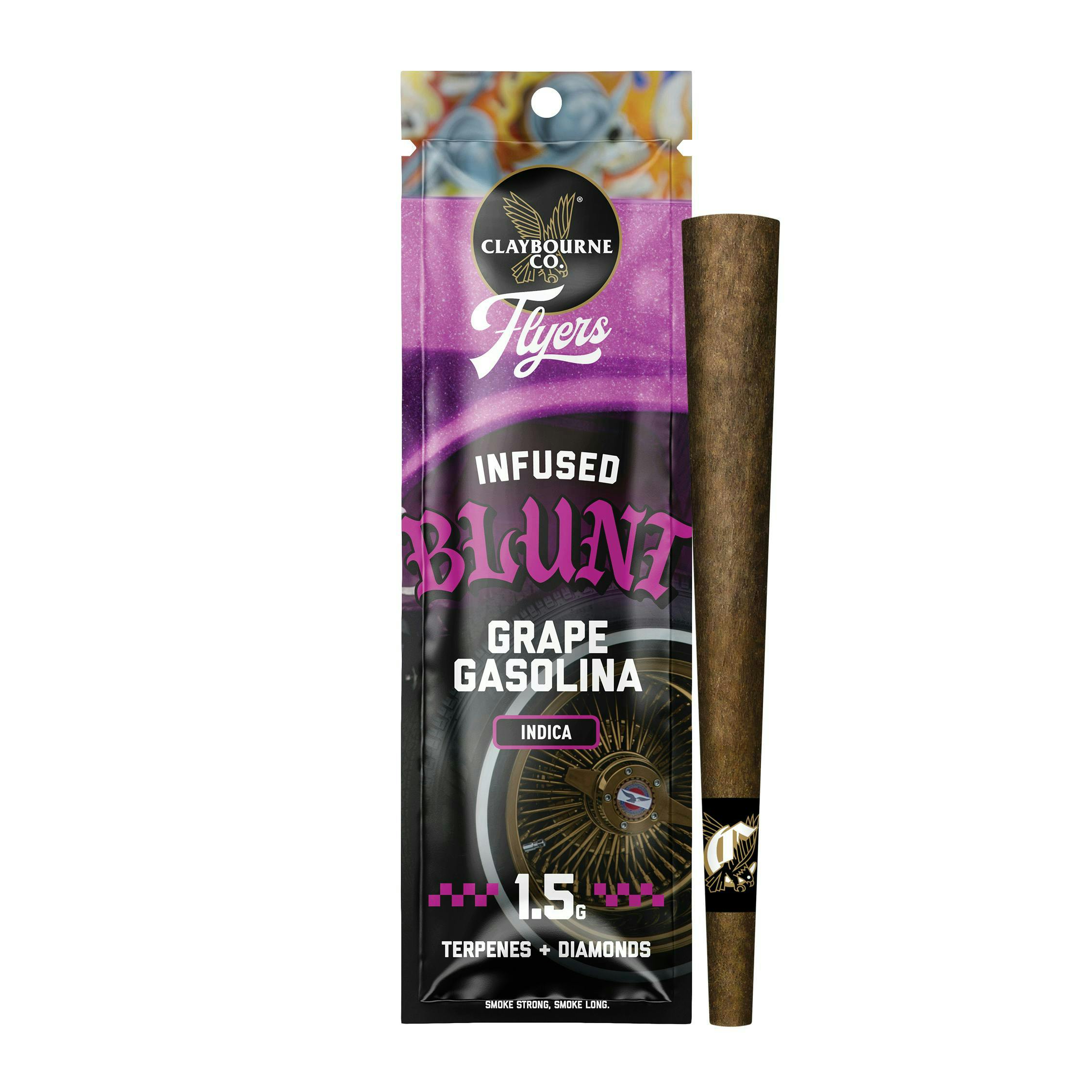
Claybourne Co.Claybourne | Grape Gasolina | Infused Blunt 1ct · 1.5g
$36.28
$41after tax

weeddispensarynearme.com
You must be 21 years or older to enter. By entering, you confirm you’re of legal age in your state to purchase cannabis.
For use only by adults 21+ • Keep out of reach of children
1 live products in stock
Quick answer · What is the Grape Gasolina cannabis strain?
Grape Gasolina arrives with the quiet authority of a strain that knows exactly what it is: a richly aromatic, indica-leaning hybrid that layers sweet, sun-dried grape over a distinctly fuel-forward undercurrent. The buds are dense and generously frosted, offering a sensory experience that rewards patience. It is a strain suited to the deliberate consumer — one who appreciates depth over novelty, and a gradual, enveloping warmth over sudden intensity.
$41after tax
About Grape Gasolina
Grape Gasolina is an indica-leaning hybrid whose precise lineage has not been uniformly confirmed across public databases, and the originating breeder has not released a fully documented genetic record. The most widely circulated accounts suggest the strain descends from a Grape-family parent — most likely a phenotype related to Grape Ape or Grapefruit — crossed with a fuel-forward, OG or Diesel-adjacent cultivar, which accounts for the pronounced petroleum and solvent notes beneath the sweeter fruit character. Grape Ape itself is a well-documented cross of Mendocino Purps, Skunk, and Afghani, originating in the early 2000s and popularized by Apothecary Genetics; that deep indica foundation is felt clearly in Grape Gasolina's growth structure and body-dominant effect profile. The Diesel side of the lineage, whether Sour Diesel, Chemdog, or a related sibling, remains contested, though the terpene expression strongly implies a Chemdog-family influence. Grape Gasolina appears to have emerged from the contemporary West Coast and mid-Atlantic craft market, where breeders have enthusiastically explored the tension between candy-forward grape cultivars and acrid, chemically complex fuel strains. Its genetic siblings — in spirit if not always in documentation — include Grape Gasoline and Grape Gas, both of which occupy a similar flavor and effect space and are sometimes confused with or marketed alongside Grape Gasolina in dispensary environments.
The onset of Grape Gasolina tends to arrive within five to ten minutes when smoked or vaped, beginning as a warm pressure behind the eyes and a softening of mental rigidity. The initial cerebral quality is mild but present — a gentle uplift in mood that eases social friction and quiets anxious internal chatter without producing the racy, heightened awareness associated with more sativa-forward cultivars. This opening phase is brief, acting primarily as a threshold before the strain's indica character asserts itself more fully. As the experience deepens into its peak, a weighted, full-body relaxation takes hold, spreading from the shoulders downward. Muscle tension dissipates gradually rather than suddenly, which gives the session a comfortable, unhurried quality. The mental state during the peak is calm and pleasantly hazy — conducive to passive enjoyment (film, music, conversation) rather than focused, analytical work. The dominant terpenes myrcene and caryophyllene are understood to contribute to this sedative, body-centered arc. Myrcene, one of the most common terpenes in cannabis, is associated in the literature with muscle-relaxing and sedative tendencies; caryophyllene, a sesquiterpene that binds to CB2 receptors, is linked to calming and anti-tension effects. The duration of the experience typically runs two to three hours at moderate consumption, with the comedown gradual and non-jarring — a slow return to baseline that tends to encourage rest rather than renewed activity. Those new to cannabis or to potent indica-leaning cultivars are well served by the standard guidance: start low, go slow.
The aromatic profile of Grape Gasolina is one of its most compelling attributes, built around an almost theatrical contrast between sweet fruit and industrial funk. The dominant terpene presence is myrcene, which provides the earthy, slightly musky backbone common to many indica-lineage cultivars — here it reads less as raw earthiness and more as the skin of a dark grape left to warm in afternoon sun. Caryophyllene adds a spicy, faintly woody underpinning that gains prominence as the nose lingers, giving the bouquet a structural complexity that prevents it from reading as merely candied. The fuel and solvent notes — a hallmark of Diesel and Chemdog-adjacent genetics — are likely attributable in part to compounds such as myrcene in higher concentrations and, depending on the phenotype, the presence of ocimene, which can contribute a sharp, slightly chemical brightness. On the palate, the smoke or vapor is notably smooth for a strain of this aromatic intensity. The initial inhale delivers the grape sweetness first, reminiscent of Concord grape or a dried raisin, with the fuel character emerging on the mid-palate and becoming more pronounced on the exhale. Secondary notes of dark berry, subtle earth, and a faint floral undercurrent — the latter potentially suggesting a trace of linalool or terpinolene depending on the specific phenotype — round out a finish that lingers with a pleasant, resinous warmth. The overall flavor experience is layered and deliberate, echoing the complexity of a well-structured natural wine.
Grape Gasolina typically presents in dense, tightly wound buds that reflect its strong indica heritage — the calyxes stack closely and the overall structure feels substantial in the hand without being brick-like. The color palette skews toward deep forest green with notable purple and violet hues developing in the leaves and sugar leaves, particularly when the plant has experienced cooler temperatures during its late flowering phase, a trait almost certainly inherited from its Grape Ape lineage. Rust-orange pistils weave through the canopy in moderate density, providing visual contrast against the darker foliage. Trichome coverage is generous and evenly distributed, giving the buds a frosted, almost silvered appearance under direct light. The resin production is visibly high, and the surface of a well-cured bud feels slightly tacky to the touch — a reliable indicator of the dense terpene and cannabinoid content that defines the strain's sensory character.
Grape Gasolina grows with the compact, bushy structure typical of indica-dominant cultivars, making it a reasonable candidate for indoor cultivation where canopy management and space efficiency are priorities. Indoors, it is generally reported to flower in approximately eight to nine weeks, which is consistent with its Grape Ape-adjacent genetics. Yields indoors tend toward moderate, benefiting meaningfully from low-stress training (LST) or a Screen of Green (ScrOG) setup that encourages lateral branching and better light penetration through the dense canopy. Outdoors, the strain performs well in temperate to warm climates with consistent sun exposure and low humidity during the final weeks of flowering, as the dense bud structure can be susceptible to moisture retention and mold pressure if airflow is inadequate. The purple and violet coloration that makes Grape Gasolina visually distinctive is best encouraged through a deliberate temperature differential — cooler nights relative to daytime temperatures in the final two to three weeks of flower. Overall difficulty is considered moderate; cultivators with a season or two of experience will find it manageable, while complete beginners may find the humidity and airflow demands require attentive monitoring.
Grape Gasolina occupies that particular niche of evening companion — a strain suited to the hours after the obligations of the day have resolved but before sleep becomes the immediate agenda. It is well-matched to solo evenings that call for mental decompression: the kind of night spent revisiting a favorite film, working through a playlist that demands attentive listening, or sitting with a book that benefits from a slowed, contemplative pace. The strain's grape and earthen depth pairs naturally with foods that share that richness of flavor — a charcuterie arrangement of aged cheeses and dried fruits, or a dark chocolate with high cacao content that echoes the raisin and berry notes in the smoke. For music, the strain's sedative warmth and slight cerebral lift find an ideal counterpart in slow-burn soul, late-period jazz, or low-tempo electronic — genres that reward passive immersion rather than active analysis. It can also serve a small, unhurried social gathering where conversation is prized over stimulus, though its indica weight means it is not well-suited to settings that require sustained alertness, physical coordination, or sharp executive function. As always, first-time consumers and those with lower tolerance are encouraged to begin with a minimal amount and allow ample time before considering additional consumption.
Grape Ape
Sharing deep Afghani and Mendocino Purps roots, Grape Ape offers the same full-body indica relaxation and distinctly grape-forward sweetness that anchors Grape Gasolina's identity.
Grape Gas
Often discussed alongside Grape Gasolina in dispensary settings, Grape Gas occupies nearly identical aromatic territory — layered grape and fuel — and produces a comparably body-dominant effect arc.
Sour Grape
A cross of Sour Diesel and Grape Ape, Sour Grape delivers a similar interplay of sweet fruit and acrid fuel with an indica-leaning profile that fans of Grape Gasolina will find familiar.
Zkittlez
For consumers drawn primarily to Grape Gasolina's fruit-candy sweetness and smooth smoke, Zkittlez offers a comparable flavor-forward experience with a relaxing, body-present indica character.
Chemdog
Those who find themselves most captivated by the fuel and chemical complexity beneath Grape Gasolina's surface will appreciate Chemdog's raw, acrid depth and its own storied Diesel-adjacent lineage.
Grape Gasolina is classified as an indica-leaning hybrid. Its growth structure, effect profile, and terpene expression all reflect a strong indica foundation — likely inherited from Grape Ape-adjacent genetics — while a fuel-forward, possibly Diesel-family parent contributes a modest cerebral opening that prevents it from being a purely sedative experience. Consumers can expect body-dominant relaxation with a mild initial mood elevation.
The flavor profile leads with Concord grape and dried dark berry on the inhale, transitioning to a pronounced fuel and solvent character on the mid-palate and exhale. Secondary notes of earth, subtle spice, and a faint resinous sweetness round out the finish. The smoke is relatively smooth for a strain of this aromatic intensity, and the lingering aftertaste carries that distinctive interplay of fruit and petroleum that defines the strain.
Grape Gasolina typically produces a brief, mood-lifting onset followed by a deeper, full-body relaxation that defines the bulk of the experience. Mental activity slows pleasantly, tension dissipates, and a calm, hazy ease settles in. It is better suited to passive enjoyment — listening, watching, resting — than to tasks requiring focus or coordination. The comedown is gradual, and many consumers find the session concludes naturally in rest or sleep.
Consumers who enjoy Grape Gasolina often appreciate Grape Ape for its shared sweetness and indica depth, Grape Gas for near-identical aromatic territory, Sour Grape for its fruit-meets-fuel balance, Zkittlez for candy-forward flavor with body-present effects, and Chemdog for those drawn primarily to the petroleum complexity beneath the fruit notes.
Grape Gasolina can be approachable for beginners, but its indica-dominant potency warrants caution. The general principle — start low, go slow — applies particularly here, as the body-weighted effects can be unexpectedly pronounced for those unaccustomed to potent cultivars. A minimal initial amount, consumed in a comfortable setting, is the appropriate starting point. New consumers should allow at least 30 minutes before assessing their experience.
Myrcene and caryophyllene are the most consistently identified dominant terpenes in Grape Gasolina. Myrcene contributes the earthy, grape-skin muskiness and is associated with sedative, muscle-relaxing tendencies. Caryophyllene adds spice and woody complexity while interacting with CB2 receptors in a manner linked to calming effects. Ocimene may also be present in some phenotypes, contributing to the sharp, fuel-adjacent brightness in the aroma profile.
Given its indica-leaning, body-sedating character, Grape Gasolina is best positioned as an evening or late-afternoon strain. It is well-suited to the hours after work and obligations have concluded — moments devoted to unwinding, passive entertainment, or quiet social time. Consuming it during daylight hours when alertness or productivity is required is not advisable, as the relaxing physical weight of the strain tends to discourage sustained activity.
Yes. Grape Gasolina produces dense, compact buds with a notable purple and violet coloration in the foliage, a trait traceable to its Grape Ape-influenced lineage and encouraged by cooler late-flowering temperatures. Rust-orange pistils provide contrast against the darker leaves, and a generous, even trichome frosting gives the buds a silvered, resinous appearance. It is a visually striking cultivar that reflects the quality of its genetic foundation.
Related strains
Pick your store
We'll show pricing, deals, and delivery zones for the store you pick. You can switch any time from the header.