THC 0.65%Indica
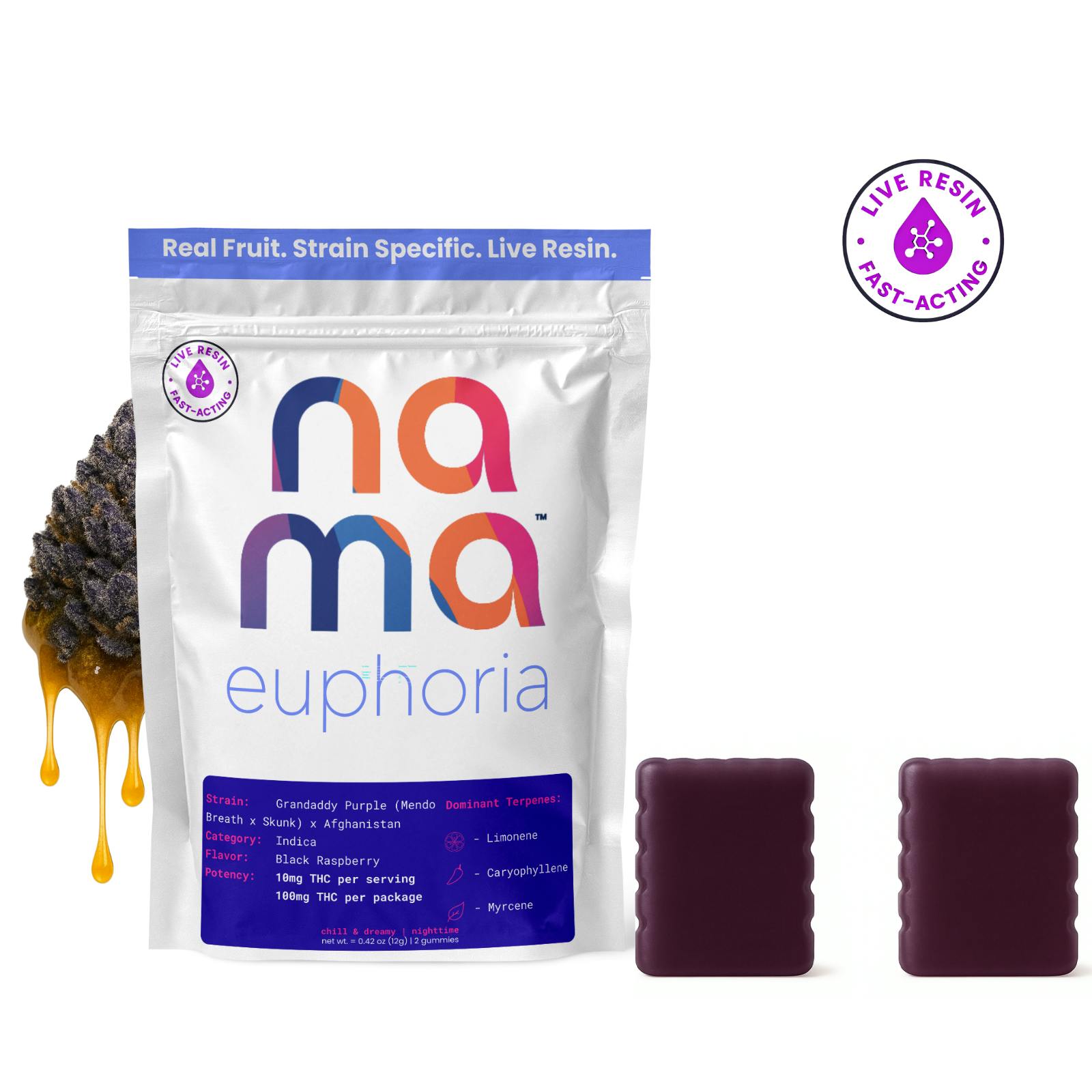
namaNama | Euphoria Grandaddy Purple - Black Raspberry | Gummy 100mg 2pk · .1g
$18.00
$20after tax

weeddispensarynearme.com
You must be 21 years or older to enter. By entering, you confirm you’re of legal age in your state to purchase cannabis.
For use only by adults 21+ • Keep out of reach of children
2 live products in stock
Quick answer · What is the Grandaddy Purple cannabis strain?
Granddaddy Purple arrives like a quiet evening settling over the California hills — deep violet buds dusted in silver trichomes, a perfume of ripe Concord grape and sweet earth, and an unhurried body warmth that asks nothing more of you than to sit still and breathe. One of the defining West Coast indicas of the modern era, it carries the kind of pedigree that earns a permanent place on any serious dispensary shelf.
$20after tax

$136after tax
About Grandaddy Purple
Granddaddy Purple — widely abbreviated GDP — was introduced to the California cannabis market in 2003 by breeder Ken Estes, a Bay Area cultivator and patient advocate who developed the strain in the San Francisco Bay region. Estes crossed two storied indica-dominant cultivars: Purple Urkle, a California landrace-influenced variety prized for its grape-candy aroma and lavender-to-deep-purple coloration, and Big Bud, an Amsterdam-bred cultivar developed by Sensi Seeds in the 1980s and recognized for its outsized yields and dense, resinous flower structure. The union of those two parents gave GDP the best of both worlds: the chromatic drama and aromatic depth of Purple Urkle combined with the generous bud mass and structural integrity of Big Bud. Within a few years of its release, GDP became a foundational reference point for the West Coast indica archetype, influencing a broad lineage of purple-hued descendants. Among the most notable offspring and close relatives are Granddaddy Bruce (a cross with Bruce Banner), GDP x OG Kush hybrids common on California menus, and numerous phenotype selections that breeders have released under names like Grand Purple and Ken's Granddaddy Purple. The strain's influence on purple-leaning genetics — from Purple Punch to numerous modern craft selections — is well-documented across Leafly, Wikileaf, and breeder accounts.
The onset of Granddaddy Purple tends to present itself within five to fifteen minutes of inhalation, beginning characteristically in the mind before settling into the body. A gentle cerebral lift arrives first — not a sharp or energetic clarity, but a soft elevation in mood, a loosening of mental static. Experienced consumers often describe this opening phase as a pleasant blanketing of the inner monologue rather than a stimulating surge, which distinguishes GDP from more sativa-forward hybrids. As the experience deepens — typically between twenty and forty minutes in — the indica character assumes center stage. A progressive physical heaviness radiates outward from the shoulders and chest, working steadily toward the extremities. This is the phase most commonly associated with GDP's reputation for full-body relaxation: muscles soften, tension held through the day begins to dissolve, and the impulse toward movement wanes. Myrcene, the dominant terpene in most GDP phenotypes, is well-supported in the literature as a modulator of sedative quality, and its concentration in this strain aligns closely with that body-forward character. Duration is generally two to three hours for experienced consumers, with the peak body sensation concentrated in the first ninety minutes. The comedown is gradual and gentle, often concluding in a calm, sleepy state rather than an abrupt return to baseline. Those newer to cannabis should approach with measured intent — the sedative arc can deepen considerably with larger intake.
The aromatic profile of Granddaddy Purple is one of the most immediately recognizable in contemporary cannabis — a dense, sweet, fruit-forward bouquet anchored by a dominant expression of myrcene. Myrcene, the most prevalent terpene in most GDP phenotypes, contributes the characteristic earthy grape and musky sweetness that greets the nose upon opening the jar. It is the compound most closely associated with GDP's ripe Concord grape signature, and its concentration helps explain the strain's distinctly relaxing aromatic character. Complementing myrcene, caryophyllene introduces a subtle spiced undercurrent — a faint black-pepper warmth that gives the sweetness structural contrast and prevents the profile from reading as purely confectionery. Pinene, where present, adds a whisper of fresh herbal greenness that evokes crushed pine needles and keeps the nose alert through the fruit. Some phenotypes show a trace of linalool, lending a faint floral quality — closer to dried lavender than fresh bloom — which deepens the purple-fruit impression and layers the aroma with quiet elegance. On the palate, GDP delivers with consistency and richness. The inhale carries sweet berry and grape, closer to juice than candy, with an earthy undertone. The exhale broadens into a soft, spiced finish where caryophyllene becomes more detectable. Vapor tends to be slightly smoother and more aromatic than combustion, preserving the terpene complexity. Either way, the flavor lingers on the palate in a pleasant, fruit-adjacent warmth.
Granddaddy Purple produces some of the most visually striking flower in the indica category. The buds are characteristically dense and compact — a structural inheritance from Big Urkle and Big Bud both — with a tightly packed calyx formation that gives the flower a substantial weight relative to its visual size. Coloration is the defining visual signature: the deep violet, indigo, and burgundy hues that saturate the buds are a product of anthocyanin pigments activated during the cool-temperature phases of the flowering cycle, and in well-grown examples the purple saturation extends uniformly through the bud rather than appearing only at the leaf edges. Set against the dark underlying tones, the pistils present in vivid orange-amber — a high-contrast detail that gives the flower a jewel-like quality under light. A generous frost of milky to amber trichomes coats the entire surface, lending a silver-white shimmer that softens the deep purples and signals the resin density cultivators prize. Overall, GDP's appearance is one that photographs well and presents with quiet authority on the shelf.
Granddaddy Purple is considered a moderately approachable cultivar for home growers, though it rewards those who invest attention in environmental management. It performs admirably both indoors and outdoors, with a typical indoor flowering window of approximately eight to eleven weeks. Indoor yields are respectable for an indica — generally positioned in the moderate-to-generous range — while outdoor plants can develop into substantial specimens in Mediterranean or similarly mild, dry climates, with harvests typically falling around late September to mid-October in Northern Hemisphere cultivation. The strain's notable purple coloration is reliably expressed but is most vivid when nighttime temperatures are allowed to drop meaningfully (into the low-to-mid 60s Fahrenheit) during the late flowering stage. This temperature differential triggers anthocyanin expression without stressing the plant unduly. GDP is relatively resistant to mold and mildew, a useful characteristic given its dense bud structure, though adequate airflow and humidity management remain important. Its compact indica growth pattern makes it well-suited to indoor spaces with height constraints, and it responds well to low-stress training techniques. The breeder Ken Estes has maintained select phenotypes for commercial licensing in California.
Granddaddy Purple is, without question, an evening strain — one that earns its place at the close of a considered day rather than at the beginning of one. Its sedative arc and physical weight make it poorly suited to moments requiring sustained focus or physical coordination, but for the hours when the objective is genuine decompression, it performs with a consistency that few cultivars match. Solo consumption on a quiet evening — perhaps paired with a long-form documentary, an immersive piece of ambient music, or simply an unhurried meal at home — allows GDP's gentle cerebral opening and deep body relaxation to unfold without interruption. For those who enjoy pairing cannabis with food, GDP's grape and spiced-earth terpene profile finds an intuitive companion in aged cheeses, dark chocolate with moderate bitterness, or a glass of still water with a wedge of citrus to brighten the palate between draws. Musically, the strain pairs naturally with slow-tempo, textured work — artists in the vein of Sade, classic Coltrane ballads, or ambient producers like Brian Eno. The common thread is unhurried depth: GDP rewards a sensory environment that asks nothing urgent of the mind.
Purple Punch
Purple Punch shares GDP's grape-forward terpene lineage and deep indica body effect, making it a natural next step for any consumer who appreciates GDP's aromatic sweetness and physical calm.
Purple Urkle
As one of GDP's direct parent strains, Purple Urkle delivers a similarly grape-drenched aroma with a slightly more sedating, less cerebral character that will feel familiar to dedicated GDP consumers.
Grape Ape
Grape Ape amplifies the candy-grape aromatic thread shared with GDP while offering a comparable full-body indica effect profile, appealing to consumers drawn to GDP's fruit-candy sweetness.
Northern Lights
Northern Lights delivers the same unhurried, body-centered relaxation and earthy-sweet aroma that defines GDP, making it an ideal alternative for consumers seeking a similarly classic indica experience.
Tahoe OG
For GDP consumers who occasionally seek a heavier, more resin-forward expression of the same late-evening sedative quality, Tahoe OG provides a complementary profile with added fuel and pine complexity.
Granddaddy Purple is a well-established indica-dominant cultivar. Bred by Ken Estes in 2003 from Purple Urkle and Big Bud — both indica-leaning parents — GDP expresses a deeply physical, body-centered effect profile typical of the indica classification. Its compact bud structure, dense calyx formation, and sedative arc are all consistent with indica-dominant genetics. Most contemporary phenotypes available in licensed dispensaries reflect this indica character clearly.
Granddaddy Purple is renowned for a rich, fruit-forward palate anchored by ripe grape and sweet berry — closer to Concord grape juice than candy, with an earthy, slightly musky undertone inherited from its myrcene-dominant terpene profile. On the exhale, a soft spiced warmth from caryophyllene becomes more prominent. The overall flavor impression is dense, sweet, and lingering, with vapor delivery tending to preserve the aromatic complexity more fully than combustion.
GDP typically opens with a gentle mood elevation and a softening of mental tension before transitioning into a progressive, full-body physical relaxation. The cerebral phase is mild and pleasant rather than energizing. As the experience matures — usually within twenty to forty minutes — a characteristic indica heaviness settles across the body. The overall duration ranges from two to three hours, concluding in a calm, often drowsy state. Beginners are encouraged to start with a modest amount and observe the full arc before continuing.
Consumers who enjoy Granddaddy Purple are frequently drawn to Purple Punch for its shared grape-forward terpene profile, Purple Urkle for its direct genetic connection and comparably sedating character, and Grape Ape for its fruit-candy aromatic expression. Northern Lights offers a similarly classic, body-centered indica experience with an earthier aroma. Tahoe OG appeals to GDP fans who occasionally seek a heavier, more resinous expression of late-evening relaxation.
Granddaddy Purple can be approachable for beginners who are mindful of its potency and indica-dominant sedative arc. Its smooth, pleasant flavor and gradual onset make the early experience accessible, but the physical heaviness in the peak phase can be surprisingly pronounced. The standard guidance applies: start with a small amount, wait a full fifteen to twenty minutes before assessing your response, and choose an evening or low-commitment context where deep relaxation is welcome rather than inconvenient.
Myrcene is the dominant terpene in most Granddaddy Purple phenotypes, contributing the characteristic earthy grape musk and supporting the strain's sedative, body-forward qualities. Caryophyllene follows as a notable secondary terpene, adding a spiced warmth that provides aromatic contrast on the exhale. Pinene and linalool appear in smaller concentrations across many phenotypes, lending faint herbal and floral nuances respectively. This terpene arrangement is consistent with the strain's well-documented aroma and effect profile.
The vivid purple, indigo, and burgundy coloration in Granddaddy Purple is produced by anthocyanins — water-soluble pigments that become visible in the plant tissue when cooler temperatures are present during the late flowering stage. This is a genetic trait inherited from Purple Urkle. When nighttime temperatures drop meaningfully in the final weeks of flowering, chlorophyll breaks down and the underlying anthocyanin pigmentation expresses. The color is a natural genetic and environmental response, not an indicator of potency or quality in itself.
Granddaddy Purple is best suited to the evening or night hours. Its sedative body effect, progressive physical heaviness, and tendency to conclude in drowsiness make it a considered choice for daytime use when tasks, focus, or mobility are required. The strain is at its most appropriate in low-demand contexts: a quiet evening at home, the hours before sleep, or any moment when the intention is genuine rest and decompression rather than activity or creative output.
Related strains
Pick your store
We'll show pricing, deals, and delivery zones for the store you pick. You can switch any time from the header.