
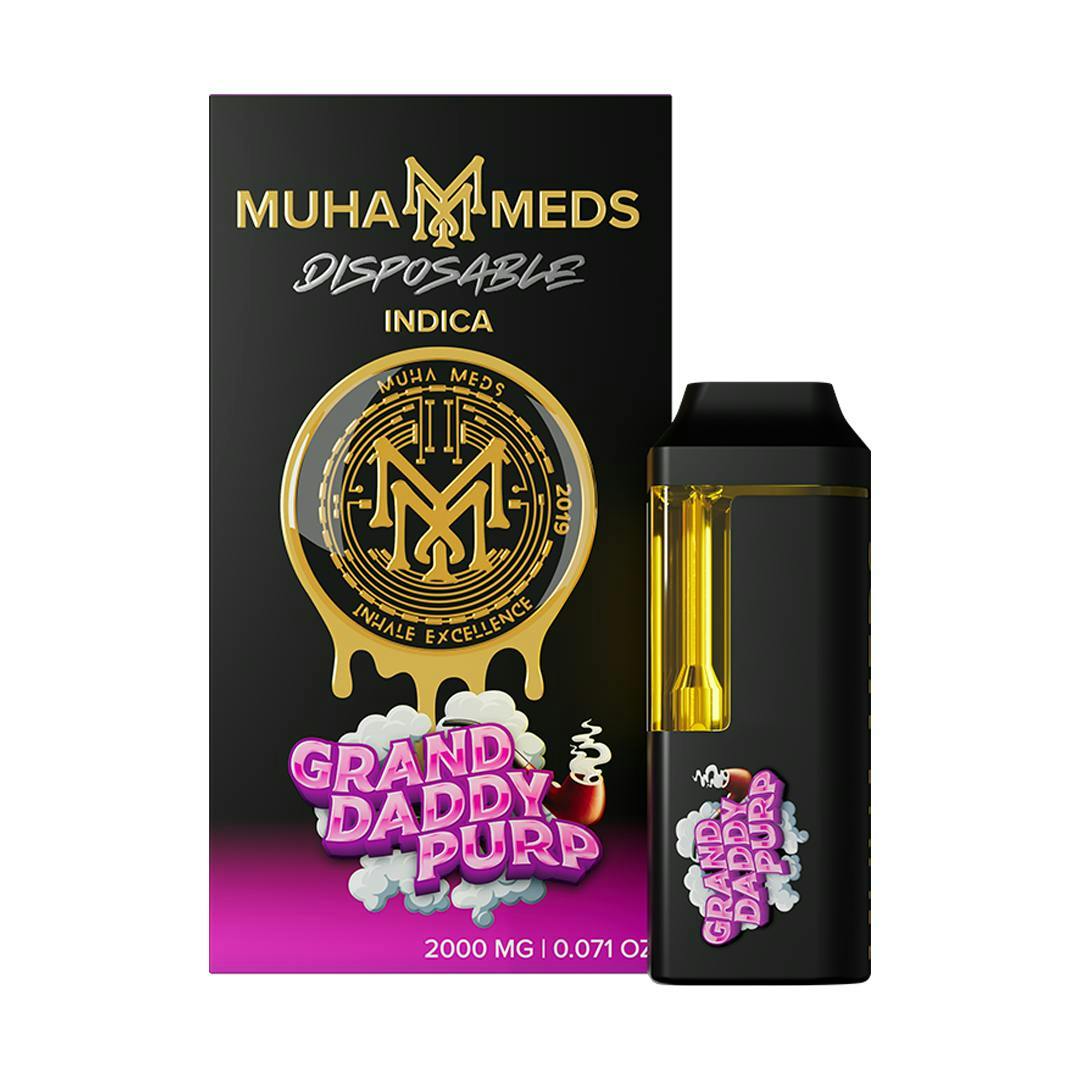
Indica
All strains Grand Daddy Purp
2 live products in stock
Quick answer · What is the Grand Daddy Purp cannabis strain?
Granddaddy Purple is California's most iconic purple indica — a deeply pigmented, grape-laden cultivar that has defined West Coast cannabis culture since the early 2000s. Its dense violet-hued buds carry an unmistakable sweetness, and its effects arrive with a measured, enveloping weight that settles across both mind and body. For those seeking a composed evening experience, few strains carry the cultural authority or the consistent character of GDP.
Shop Grand Daddy Purp · 2 of 2 live products
THC 77.3%Indica
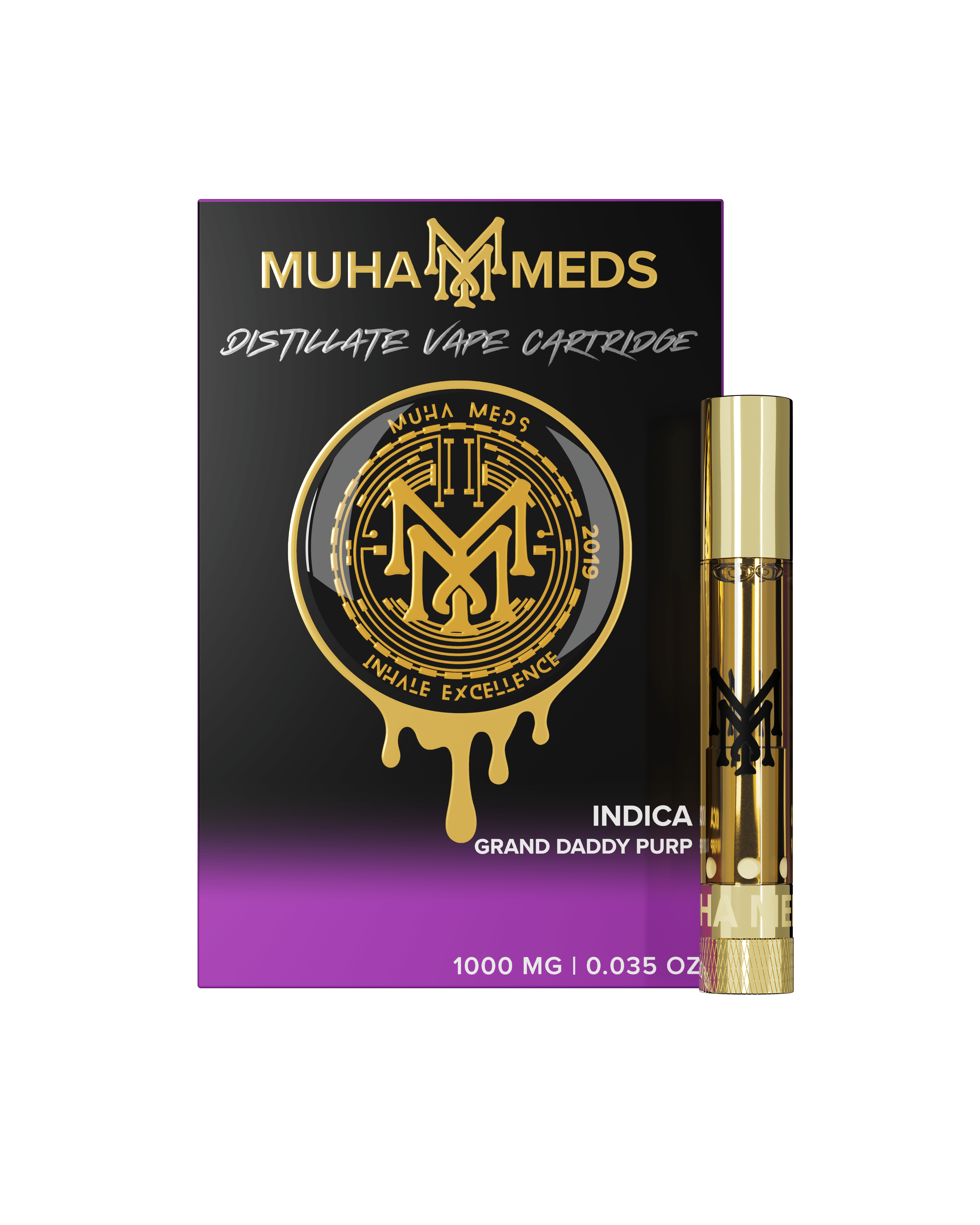
Muha MedsMuha Meds - Grand Daddy Purp - 510 Cartridge | Indica · 1g
$18.00
$20after tax
About Grand Daddy Purp
Everything to know about Grand Daddy Purp.
Lineage & origin
Granddaddy Purple — commonly abbreviated GDP — was developed and popularized by Ken Estes of Grand Daddy Purp Collective in the San Francisco Bay Area, with the strain reaching wider recognition around 2003. Estes crossed two firmly established California landrace-adjacent cultivars: Purple Urkle, a grape-scented indica of disputed but likely Mendocino County origin, and Big Bud, the high-yielding Amsterdam classic bred by Sensi Seeds in the 1980s. The pairing was deliberate: Purple Urkle contributed the deep anthocyanin-driven pigmentation and the distinctively sweet, berry-forward aroma, while Big Bud added structural mass, generous calyx development, and broader bag appeal. The strain arrived at a moment when the California medical market was beginning to codify its aesthetic preferences, and GDP rapidly became a shorthand for what a quality purple indica should look and smell like. Its anthocyanin expression — which produces the purple, blue, and lavender hues in cold-finish growing environments — made it visually distinctive in any dispensary case. Over the following decade, GDP was used extensively as a parent in subsequent breeding projects, contributing to well-regarded offspring such as Granddaddy Banner (a GDP × Bruce Banner cross) and various Purple phenotype hybrids circulating through both the California and Colorado markets. Ken Estes has maintained that the original cut has never been officially licensed beyond his own operation, making truly authentic GDP a matter of provenance as much as genetics.
Effects
The experience of Granddaddy Purple tends to unfold in two distinct movements. The onset, which typically arrives within five to ten minutes of inhalation, carries a gently euphoric cerebral quality — a lightening of mental weight rather than a sharp cognitive elevation. This initial phase is relatively brief and should not mislead the consumer into underestimating what follows. The strain's indica dominance, underpinned by a terpene profile rich in myrcene, asserts itself steadily over the following fifteen to thirty minutes, at which point a broad physical relaxation begins to settle across the shoulders, limbs, and lower back. At its peak, GDP is characterized by a dreamy, contemplative quality — thoughts move at a slower, more meandering pace, and the body registers a pleasant heaviness that discourages restlessness. The effect duration is substantial, often extending two to three hours in moderate consumption, with the physical sedation outlasting the cerebral component. The comedown is gradual rather than abrupt, and many consumers report a natural drift toward sleep as the session concludes. Myrcene is the terpene most directly associated with the deeply relaxing, muscle-softening quality GDP is known for, while caryophyllene adds a subtle grounding note that some associate with a settled, even-keeled disposition. Consumers newer to high-potency indicas should approach GDP with patience — its delayed physical onset rewards the deliberate and penalizes the hasty.
Aroma, flavor & terpenes
Granddaddy Purple presents one of the more immediately recognizable aromatic profiles in the contemporary cannabis canon. At the dominant level, myrcene is unmistakably present, lending the characteristic musky earthiness that forms the foundation of the scent — ripe, almost overripe, in the way of warm fruit left to concentrate in the afternoon sun. Layered above this base are the grape and berry notes most consumers associate with the strain, a signature that traces back to its Purple Urkle parentage and is reinforced by the caryophyllene present in secondary concentrations. On closer inspection, there is a subtle floral sweetness that some attribute to low-level linalool, softening the fruitier edges into something closer to a berry compote than raw grape juice. Pinene appears in trace amounts in well-grown specimens and contributes a faint herbal freshness that keeps the profile from reading as one-dimensional or cloying. The overall aromatic impression is dense, sweet, and distinctly purple — a quality that is nearly synesthetic in how consistently consumers describe it before seeing the buds. On the palate, GDP delivers its grape and berry character with notable fidelity to the nose. Combustion or vaporization at moderate temperatures opens with a smooth, sweet inhale and finishes with a mild earthy, almost woody exhale — the myrcene and caryophyllene asserting themselves as the vapor cools. The smoke is generally dense and full-bodied; in a well-cured specimen, the finish lingers pleasantly without harshness.
Appearance
Granddaddy Purple is among the most visually striking cultivars produced by the California market, and its appearance has become something of a benchmark for the purple indica category. The buds are dense and tightly wound, reflecting the Big Bud lineage in their compact calyx structure and substantial physical weight relative to size. Coloration ranges from deep forest green in the interior leaves to vivid violet, indigo, and occasionally near-black in the outer sugar leaves and calyxes — a variation that is most pronounced when the plant finishes in cooler nighttime temperatures, which activate the anthocyanin pigmentation. Orange to rust-colored pistils weave through the bud structure in moderate density, providing a warm contrast to the cooler purple tones. Trichome coverage is generous and consistent across well-grown examples, producing a frosted, resinous surface that catches light with a crystalline quality. The overall visual effect is one of deliberate richness — a bud that reads as premium before it is ever opened.
Growing notes
Granddaddy Purple is considered a moderately approachable cultivar for intermediate home growers, though the original authentic cut has historically been difficult to source outside of Ken Estes's licensed operation. Commercially available seeds and clones exist, though their fidelity to the original phenotype varies. The strain performs well both indoors and in outdoor Mediterranean-style climates, preferring moderate humidity and warm days with cool nights — the temperature differential is the key variable for achieving the anthocyanin-driven coloration the strain is known for. Indoors, GDP typically flowers in approximately eight to eleven weeks and produces moderate to generous yields given adequate light intensity and canopy management. Outdoor cultivation in a suitable climate — Northern California being the historical ideal — can yield substantial harvests, with plants finishing in late September to mid-October in the Northern Hemisphere. The plant's indica structure keeps it relatively compact, making it manageable in constrained grow spaces. Cultivators interested in maximizing the purple expression should introduce cooler temperatures in the final two weeks of flowering. Resistance to mold and mildew is average; attentive airflow is advisable given the density of the bud structure.
When it's best enjoyed
Granddaddy Purple is, with little ambiguity, an evening and nighttime cultivar. Its arc — from gentle cerebral ease into sustained physical relaxation — makes it poorly suited to mornings, active midday schedules, or any context requiring sharp cognitive engagement. Where it excels is in the deliberate unwinding that follows a demanding day: the hour between dinner and sleep, a quiet evening at home with low lighting and no obligations pressing forward. Solo, it pairs naturally with slow, immersive listening — artists whose work rewards patient attention, such as orchestral jazz or ambient electronic music, align with GDP's contemplative, unhurried character. For food pairing, the strain's grape and berry terpene profile finds a natural counterpoint in aged cheeses, dark chocolate, or a modest charcuterie selection, where the contrast of savory and sweet mirrors the complexity of the aroma. In a social context, GDP is best suited to small, relaxed gatherings — conversations that drift rather than debate, evenings that end early by choice rather than necessity. Those new to cannabis or returning after a long absence should begin conservatively; the strain's physical depth arrives later than the initial impression suggests.
If you like Grand Daddy Purp, also explore
Purple Urkle
As one of GDP's parent strains, Purple Urkle shares the grape-forward sweetness and deeply relaxing indica character, making it the most direct point of comparison for fans of GDP's aromatic profile.
Grape Ape
Grape Ape shares GDP's purple visual identity, myrcene-dominant terpene profile, and full-body sedative quality, and is a natural next exploration for those drawn to the berry-and-earth aromatic family.
Northern Lights
Northern Lights offers a similarly classic indica pedigree with a resinous, earthy-sweet profile and body-forward relaxation that appeals to consumers who appreciate GDP's unhurried, grounding character.
Blackberry Kush
Blackberry Kush echoes GDP's dark fruit aromatics and heavy evening-use disposition, with the added complexity of a fuel-tinged Kush backbone beneath the berry sweetness.
Purple Punch
Purple Punch, a cross of Larry OG and Granddaddy Purple itself, carries many of GDP's signature qualities — grape candy sweetness, vivid pigmentation, and sedative depth — with a slightly more dessert-forward aromatic profile.
Common questions
Is Granddaddy Purple indica or sativa?+
Granddaddy Purple is a pure indica-dominant cultivar, the product of a Purple Urkle and Big Bud cross developed in Northern California. Its effect profile, bud structure, and growth characteristics are all consistent with the indica classification — dense buds, broad physical relaxation, and a sedative arc that makes it most appropriate for evening use rather than daytime activity.
What does Granddaddy Purple taste like?+
Granddaddy Purple delivers a pronounced grape and mixed berry flavor on the inhale, driven primarily by its myrcene and caryophyllene terpene content and the aromatic heritage of its Purple Urkle parent. The exhale transitions toward a softer, earthier finish with mild woody and herbal undertones. In a well-cured specimen, the smoke or vapor is smooth and full-bodied, with the sweet fruit character remaining present through the finish.
What are the typical effects of Granddaddy Purple?+
GDP typically begins with a mild cerebral ease — a quiet mental loosening — before transitioning over twenty to thirty minutes into a pronounced full-body relaxation. The physical component is the dominant character of the experience: heavy, unhurried, and conducive to rest. The duration is substantial, often two to three hours, with a gradual drift toward sleepiness as the session concludes. It is best suited to low-activity evening contexts.
What strains are similar to Granddaddy Purple?+
Consumers who appreciate Granddaddy Purple tend to also enjoy Purple Urkle, GDP's own parent strain; Grape Ape, which shares the myrcene-heavy, berry-forward aromatic family; Purple Punch, a direct GDP offspring with a candy-sweet profile; Northern Lights, for its classic indica pedigree and body-forward relaxation; and Blackberry Kush, which pairs dark fruit aromatics with a Kush earthiness beneath.
Is Granddaddy Purple good for beginners?+
GDP can be enjoyed by beginners, but its delayed physical onset and substantial sedative depth merit a cautious approach. The initial experience may feel milder than its full effect warrants, which can lead newer consumers to overconsume before the peak arrives. Following a start-low, go-slow approach — allowing at minimum thirty minutes between inhalations — is advisable. Setting matters too: a relaxed home environment without commitments is the appropriate context.
What are the dominant terpenes in Granddaddy Purple?+
Myrcene is the most prominent terpene in Granddaddy Purple, responsible for its musky, ripe-fruit earthiness and its deeply relaxing physical character. Caryophyllene appears as a significant secondary terpene, contributing a subtle spice and a grounding quality to the experience. Linalool is present in smaller concentrations in many phenotypes, adding a faint floral softness to the aromatic profile, while trace pinene provides a mild herbal freshness.
Where does Granddaddy Purple come from?+
Granddaddy Purple was developed by Ken Estes in the San Francisco Bay Area and gained wide recognition around 2003. It is a cross of Purple Urkle — a Mendocino County-origin indica — and Big Bud, the high-yielding cultivar bred by Sensi Seeds in Amsterdam during the 1980s. Estes's operation, Grand Daddy Purp Collective, has maintained stewardship of the original genetics, though numerous phenotypes and named descendants now circulate broadly through the legal market.
When is the best time of day to use Granddaddy Purple?+
Granddaddy Purple is firmly an evening and nighttime cultivar. Its effect arc moves steadily from mild cerebral relaxation toward deep physical sedation, making it poorly suited to mornings, active afternoons, or any context requiring sustained focus or physical coordination. The ideal window is the transition between the end of the day and sleep — an hour or two before bed, in a comfortable, low-demand setting where the body can fully receive the experience.
Related strains