THC 30.6%Hybrid
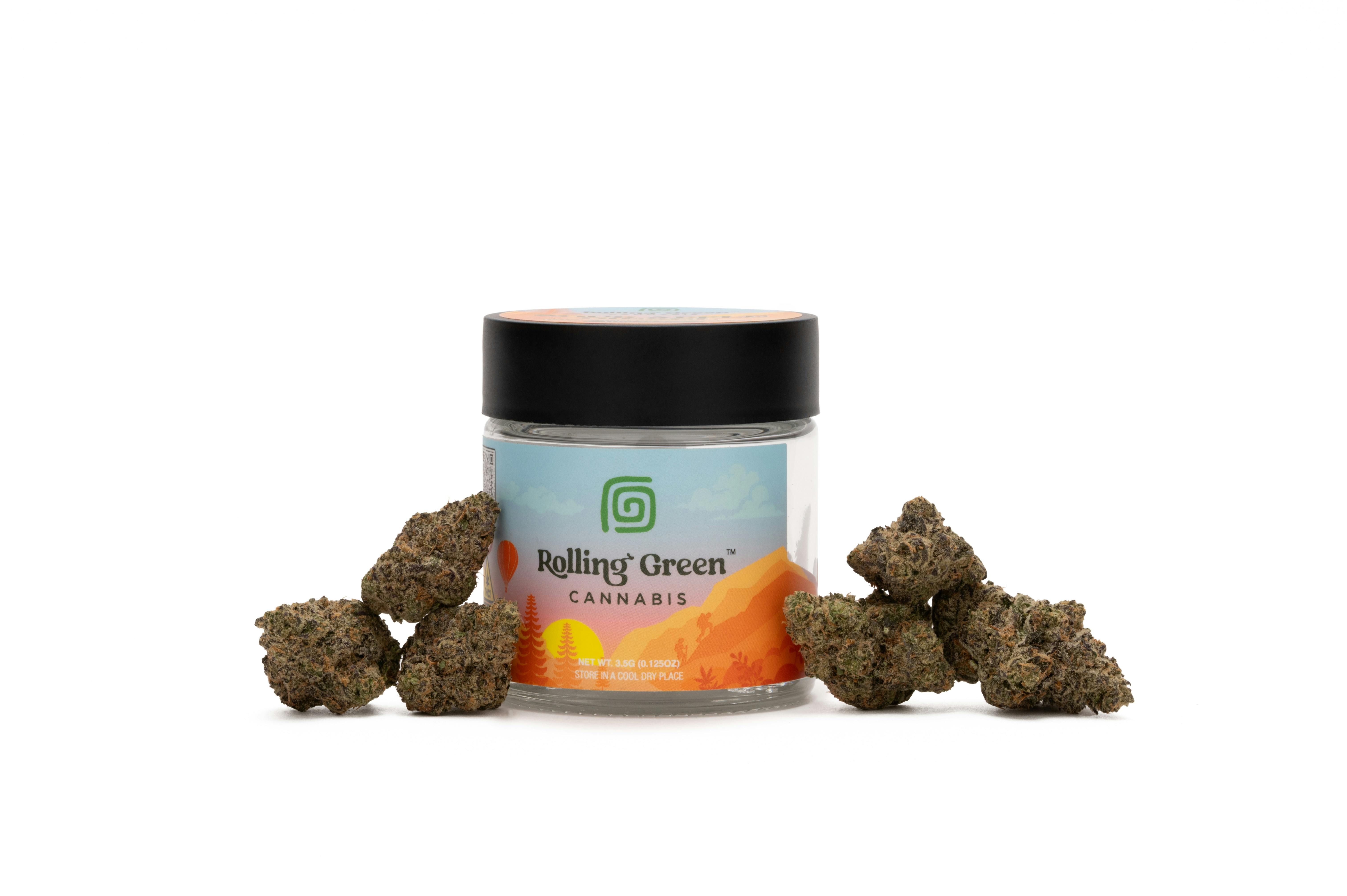
Rolling Green CannabisRolling Green | Breakfast of Champions | Flower · 3.5g
$44.25
$50after tax

weeddispensarynearme.com
You must be 21 years or older to enter. By entering, you confirm you’re of legal age in your state to purchase cannabis.
For use only by adults 21+ • Keep out of reach of children
1 live products in stock
Quick answer · What is the Breakfast of Champions cannabis strain?
Breakfast of Champions arrives with the kind of quiet confidence that makes a morning ritual feel intentional. A balanced hybrid that leans gently toward the cerebral without abandoning the body, it carries a terpene profile reminiscent of bright citrus and damp earth — the olfactory equivalent of stepping outside just after dawn. For the New York adult-use consumer who values clarity alongside ease, this is a strain worth lingering over.
$50after tax
About Breakfast of Champions
Breakfast of Champions is a hybrid whose precise lineage has not been uniformly documented across major public cannabis databases, making definitive parent attribution difficult. Several catalogue entries suggest a cross involving Chemdawg and an OG Kush-adjacent cultivar, which would situate it within one of cannabis's most influential genetic corridors — a lineage responsible for strains that reshaped American connoisseur culture through the 1990s and 2000s. Chemdawg itself carries a famously contested origin story, believed by many historians of the plant to have emerged from a chance bagseed discovery at a Grateful Dead concert in the early 1990s, later developed by the grower known as Chemdog. If the OG Kush connection holds, Breakfast of Champions inherits a Californian pedigree — OG Kush's own lineage tracing back to a Hindu Kush landrace crossed with Chemdawg and Lemon Thai, according to widely cited accounts. The hybrid positioning of Breakfast of Champions — neither hard sativa nor heavy indica — is consistent with this parentage. Genetic siblings in this family tree would include strains like Sour Diesel and Ghost OG, both of which share overlapping terpene signatures and effect profiles. Because the breeder behind this particular cut has not been publicly named with consistency across sources, shoppers should treat the lineage as probable rather than confirmed.
The onset of Breakfast of Champions tends to arrive within five to fifteen minutes of inhalation, which is characteristic of a well-cured, terpene-forward hybrid. The initial wave is predominantly cerebral — a brightening of attention and a loosening of mental friction that feels less like stimulation and more like the removal of static. This quality aligns with a limonene-forward terpene profile, as limonene has been associated in preliminary research with elevated mood and reduced tension, though individual responses vary considerably. At the peak, the experience settles into a middle ground: the mind remains engaged and present while the body receives a measured, non-sedating ease. This balance is what earns it the hybrid designation in the truest sense — neither the racy edge of a pure sativa nor the gravitational pull of an indica-dominant cultivar. Duration is typically moderate, with most consumers reporting a two-to-three hour arc before the experience gently recedes into a calm, functional baseline. The comedown is notably clean; Breakfast of Champions is not widely reported to produce the lethargy that sometimes follows more myrcene-heavy cultivars. As with any cannabis experience, cannabinoid sensitivity differs by individual, and those newer to adult-use consumption are encouraged to start low and go slow, allowing time between sessions to assess their response.
The nose of Breakfast of Champions opens with a prominent citrus register — bright, slightly waxy lemon peel rather than sweet orange juice — which points to a meaningful limonene concentration. Limonene, one of the most recognizable terpenes in the cannabis lexicon, is shared with lemon rind, rosemary, and juniper, and contributes both the sharp top note and an undercurrent of herbal brightness. Beneath that citrus layer, myrcene grounds the profile: earthy, faintly musky, and reminiscent of ripe mango skin or fresh hops. Myrcene is the most commonly occurring terpene in cannabis and is understood to contribute to the sedation-adjacent quality in heavier cultivars, though at moderate concentrations it functions more as a structural base than a sedating force. A secondary note of beta-caryophyllene introduces a dry spice — think cracked black pepper or a well-aged clove — which adds dimensionality without sharpness. On the palate, the smoke or vapor presents as smooth and moderately full-bodied, with the citrus notes most prominent on the inhale and the earthy, spiced finish emerging through the exhale. There is no pronounced sweetness, which gives it an adult, composed character on the palate — closer to a dry white wine than a dessert. The aftertaste is clean and herbal, dissipating without heaviness.
Breakfast of Champions typically presents as a medium-to-dense bud with a structure that reflects its hybrid genetics — not the tight, golf-ball compression of a pure indica, nor the elongated, wispy architecture of a sativa-leaning cultivar. The calyxes stack with deliberate density, and the overall silhouette is compact without being hard. Trichome coverage is generous, lending the flower a frosted, almost silvery quality under direct light — consistent with the Chemdawg lineage's reputation for resin production. The base color runs from medium to deep forest green, with occasional hints of sage, and pistils — the fine, hair-like structures that signal maturity — appear in shades of amber to burnt orange, threading through the trichome layer with visible contrast. Under close inspection, the surface texture has a slightly tacky quality, which is an indicator of fresh, well-preserved terpene content.
For the cultivator-curious consumer, Breakfast of Champions presents as a moderately challenging grow — rewarding to those with some prior experience but potentially demanding for first-time home cultivators. Its probable Chemdawg and OG Kush heritage suggests a preference for a controlled indoor environment where temperature, humidity, and airflow can be managed with precision. OG-adjacent genetics are known to be sensitive to environmental fluctuations and are prone to issues with powdery mildew if humidity is not kept in check during the flowering phase. Flowering time, consistent with its likely lineage, falls in the range of eight to nine weeks indoors. Outdoor cultivation is possible in warm, Mediterranean-style climates with low humidity in the final weeks before harvest, though indoor production tends to yield more consistent terpene expression and resin density. Indoor yields are typically moderate — respectable for a craft cultivator rather than exceptional by commercial standards. Training techniques such as low-stress training or light topping are generally compatible with this growth habit and can improve canopy evenness and light penetration.
Breakfast of Champions earns its name most honestly in the earlier hours — late morning or early afternoon, when the day holds possibility but has not yet accumulated its weight. Its balanced, clarity-forward character makes it well-suited to the kind of focused creative solitude that benefits from a quieted interior monologue: writing, sketching, working through a complex design problem, or simply reading something that demands full presence. It is not a strain that calls for a crowded room, though a small gathering of similarly-minded company — a Sunday brunch, a studio session, a long walk through a park in autumn — finds it equally accommodating. Given the citrus and earthy terpene profile, it pairs naturally with foods that share those registers: a dish built around preserved lemon and fresh herbs, or a pour of a mineral-driven natural wine. Musically, the experience aligns with something considered and textural — jazz with space in it, or a well-curated ambient record that rewards attention without demanding it. The overall sensibility is one of purposeful ease: present, unhurried, and composed.
Chemdawg
Fans of Breakfast of Champions who appreciate its sharp, fuel-edged citrus nose and cerebral clarity will find Chemdawg a probable genetic ancestor and a natural next step in exploration.
OG Kush
The earthy, lemon-pine foundation and balanced body-mind effect of OG Kush mirrors much of what Breakfast of Champions delivers, making it a reliable companion for those who enjoy that classic West Coast character.
Sour Diesel
Those drawn to the energizing, socially open quality of Breakfast of Champions will recognize a familiar brightness in Sour Diesel's diesel-citrus profile and its long-standing reputation for daytime functionality.
Jack Herer
If the morning clarity and creative focus of Breakfast of Champions resonates, Jack Herer's piney, spice-forward profile and reliably uplifting character offer a comparable but distinctly earthy creative companion.
Ghost OG
A phenotype within the OG Kush family, Ghost OG shares the resinous density and citrus-earth terpene signature that defines the broader lineage Breakfast of Champions likely inhabits.
Breakfast of Champions is classified as a balanced hybrid. It does not lean strongly in either direction — the onset carries a cerebral, attention-clarifying quality associated with sativa-dominant cultivars, while the body component offers a measured ease without the heaviness typical of indica-dominant strains. It occupies the middle ground in a considered, functional way.
On the palate, Breakfast of Champions presents with bright citrus on the inhale — specifically closer to lemon peel than sweet fruit — followed by an earthy, lightly spiced finish on the exhale that reflects its caryophyllene and myrcene content. The smoke or vapor is smooth and moderately full-bodied, with no pronounced sweetness, giving it a dry, composed flavor profile.
The experience typically begins within five to fifteen minutes as a cerebral brightening — a reduction in mental friction rather than stimulation. At its peak, the mind remains engaged while the body settles into a non-sedating ease. The arc lasts approximately two to three hours and resolves cleanly, without the heavy comedown associated with more myrcene-dominant cultivars. Individual responses vary.
Consumers who enjoy Breakfast of Champions often find common ground with Chemdawg, OG Kush, and Sour Diesel — strains that share its citrus-earth terpene profile and balanced, functional effect character. Jack Herer and Ghost OG are also frequently cited as comparable experiences, particularly for those drawn to creative clarity and moderate body ease.
As a balanced hybrid, Breakfast of Champions is more accessible than potent indica-dominant or high-THC sativa cultivars, but no strain is universally gentle. Those new to adult-use cannabis in New York are advised to start with a small amount and allow adequate time before reassessing. The clean, balanced character makes it less disorienting than some alternatives, though individual sensitivity always applies.
Based on its reported aroma and effect profile, the dominant terpenes in Breakfast of Champions are likely limonene, myrcene, and beta-caryophyllene. Limonene contributes the bright citrus top note and mood-elevating quality; myrcene grounds the profile with earthy depth; and caryophyllene adds a dry, peppery finish. Terpene profiles can shift between harvests and cultivators.
The precise lineage of Breakfast of Champions has not been uniformly confirmed across public cannabis databases. The most commonly cited parentage points to a Chemdawg and OG Kush-adjacent cross, which would place it within one of cannabis's most storied genetic families. Because the originating breeder has not been publicly named with consistency, the lineage should be understood as probable rather than definitively established.
Its name is something of a guide: Breakfast of Champions tends to perform well in late morning to early afternoon, when its clarity-forward, balanced character can complement focused activity, creative work, or relaxed social time. It does not carry the sedating weight of a late-evening strain, making it a considered choice for daylight hours among adult consumers in New York.
Related strains
Pick your store
We'll show pricing, deals, and delivery zones for the store you pick. You can switch any time from the header.